

We measured what actually happens to older cards of a Pokémon when a new set drops featuring that Pokémon. Across 2,008 events spanning 43 sets and 75 featured Pokémon, the popular "pump before, fade after" story doesn't show up. Old cards drift up slowly, peak 1 to 3 months AFTER release, and the effect depends entirely on which Pokémon you're talking about.
The belief we tested
Spend any time in Pokémon investing communities and you'll see the same framing repeated:
A new set is coming that features Pokémon X. The older cards of Pokémon X pump in the lead-up. Then they "fade" once the new set is in collectors' hands. Buy the rumor, sell the news.
It sounds intuitive. Hype creates demand. Attention rotates to the new product. Older cards cool off.
Most participants behave as if this is true.

The comment above is one of dozens we've seen with the same framing. It's the conventional wisdom of the hobby.
What we measured
For every new set in our window, we identified its featured Pokémon — the base Pokémon name of the top three cards in the set ranked by current PSA-10 price.
We then found every older card of that Pokémon — released at least six months before the new set — and measured what those older cards did in the six months before release and six months after.
Plus a high-resolution daily sub-study covering 579 events across 14 sets released since 2024.
Finding 1: There is no fade
We tracked the typical older card across 360 days — six months before release through six months after. We compared it against a control group: matched cards of the same era and same price band but of Pokémon NOT featured in any nearby release.
The control isolates the release-cycle effect from general market drift.
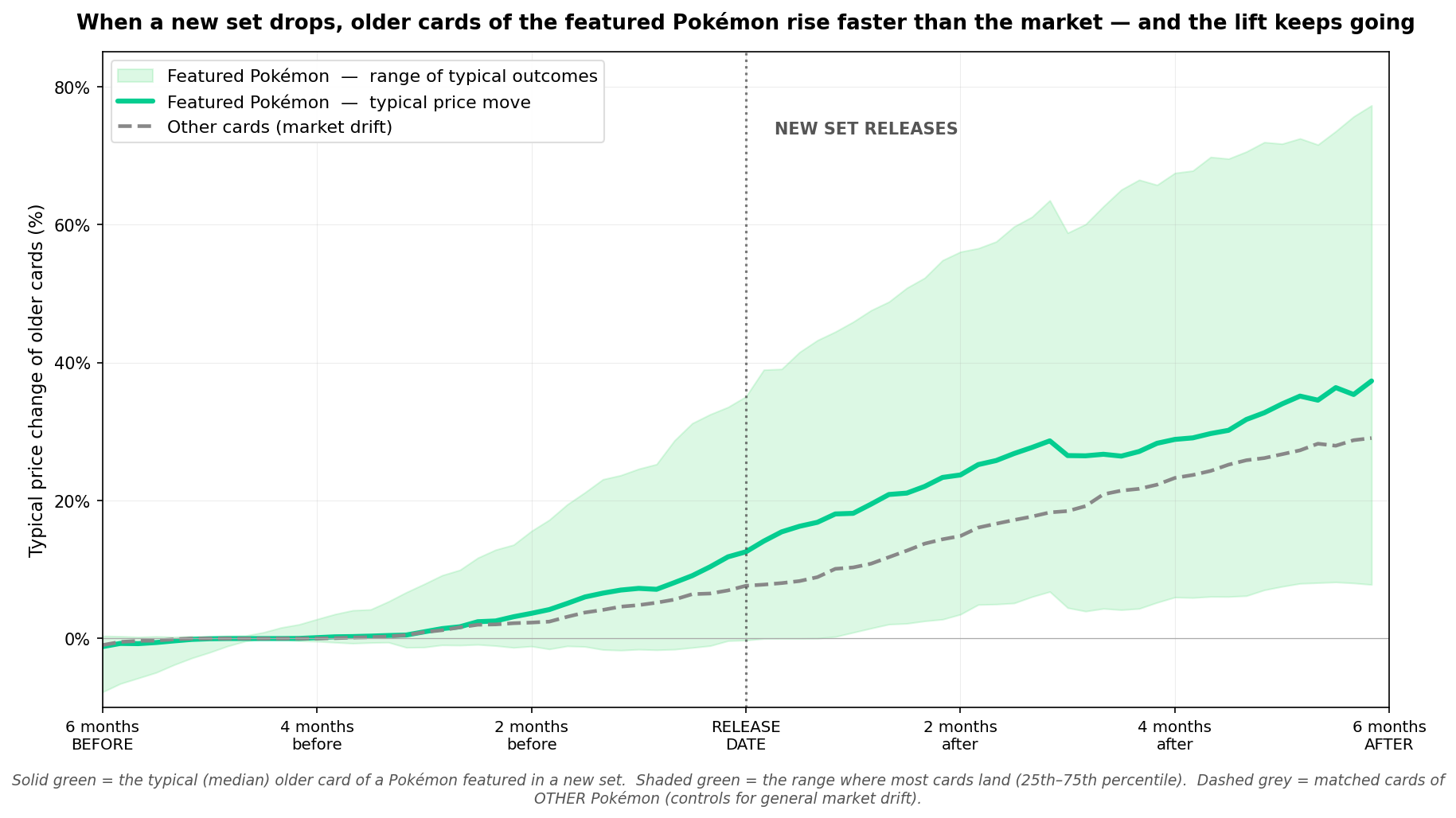
What the chart shows, in plain words:
- Both featured and control prior cards drift upward — the market has been generally bullish.
- The featured cards (green) start pulling ahead about two months before release.
- The gap widens through release week and keeps widening for three more months.
- It begins narrowing slightly six months out — but the featured line never falls back.
The same data, broken into time windows:
| Time window | Featured prior cards | Control cards | Release-attributable lift |
|---|---|---|---|
| 6 → 3 months before release | 0.0% | 0.0% | 0.0% |
| 3 → 1 months before release | +3.3% | +2.4% | +0.9% |
| 1 month before → 1 week after | +10.4% | +6.4% | +4.0% |
| 1 week → 1 month after | +16.3% | +8.3% | +7.9% |
| 1 → 3 months after | +23.1% | +14.4% | +8.7% |
| 3 → 6 months after | +29.8% | +24.8% | +5.0% |
The release-attributable lift peaks at +8.7% in the 1-to-3-months-after window.
Not before release. Not on release week. After.
Finding 2: Which Pokémon matters more than the cycle
The aggregate hides the most useful pattern in this entire study.
Some featured Pokémon's older cards lift consistently when new sets feature them. Some don't react at all. A few actually fall.
| Pokémon | Events | 1–3 months after | Read |
|---|---|---|---|
| Pikachu | 296 | +9.4% | Consistent lift |
| Gengar | 89 | +8.6% | Consistent lift |
| Gardevoir | 53 | +8.9% | Borderline lift |
| Vaporeon | 48 | +4.4% (+15.3% at 6 mo) | Delayed lift |
| Umbreon | 50 | +3.4% (+16.9% at 6 mo) | Delayed lift |
| Bulbasaur | 79 | +1.2% | Flat |
| Charizard | 275 | −2.0% | No lift |
| Mew | 51 | −6.6% | Falls |
| Dragonite | 45 | −7.7% | Falls |
| Venusaur | 79 | −9.5% | Falls |
| Lugia | 39 | −8.7% (−22.3% at 6 mo) | Falls hard |
The Charizard surprise
Charizard is the most-discussed Pokémon in collecting. New sets featuring Charizard have happened repeatedly in our study window.
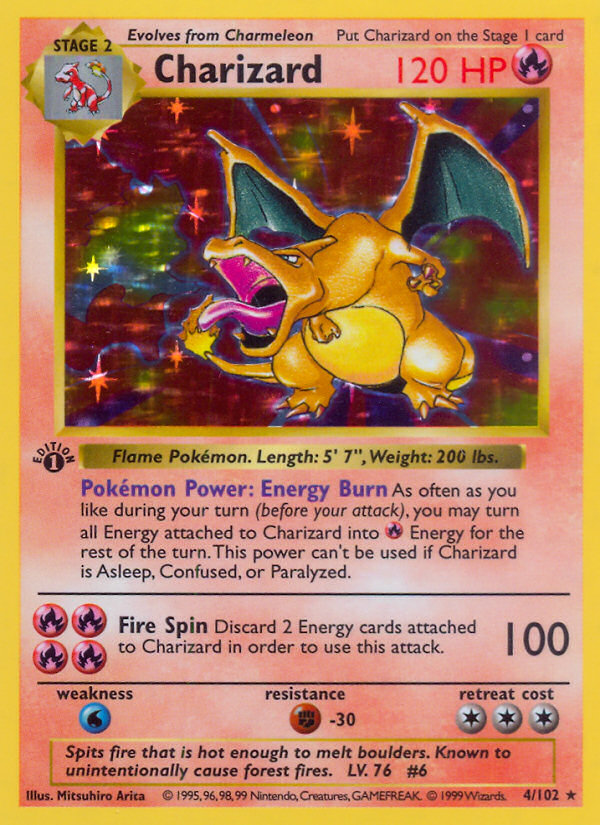
Charizard — the "no lift" archetype
Across 275 events spanning 6 sets that featured Charizard, older Charizard cards moved an average of −2.0% in the months after release.
The 90% confidence range was −5.8% to 0.0%. Not a single statistically meaningful lift across 275 measured events.
Reading: the Charizard market is so saturated and so continuously priced-in that incremental Charizard product doesn't move the marginal collector. The attention is already constant. New product doesn't shock it.
Pikachu: the opposite story
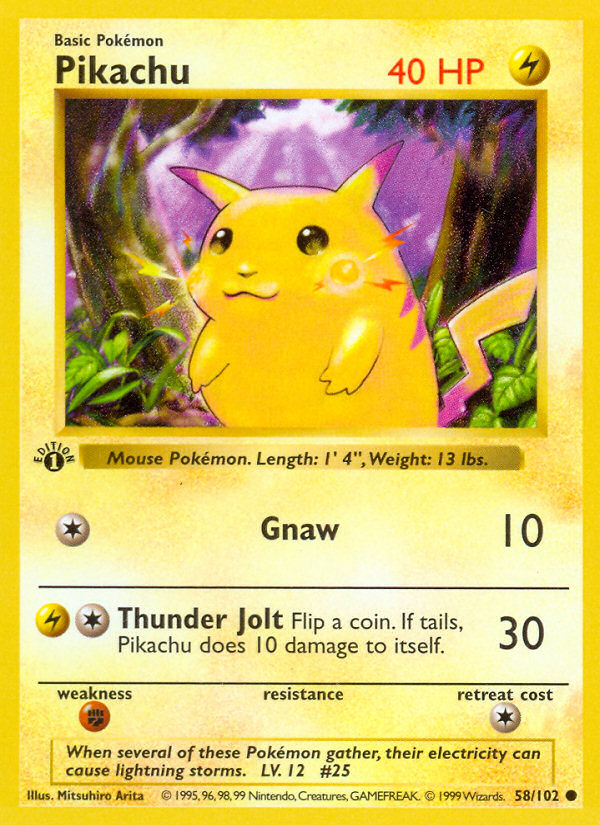
Pikachu — the "consistent lift" archetype
Across 296 events across 6 sets featuring Pikachu, older Pikachu cards moved an average of +9.4% in the months after release. The 90% confidence range was +3.7% to +14.1% — entirely positive.
Reading: every time a new set has put Pikachu in the spotlight, the existing market of older Pikachu cards has, on average, gotten a real lift from the attention. The Pikachu base is broader, the attention isn't already saturated, the marginal new collector matters.
The delayed lifts
Some Pokémon's cards barely move in the first month after release, then lift hard at the six-month mark. These are arguably the most interesting cases.
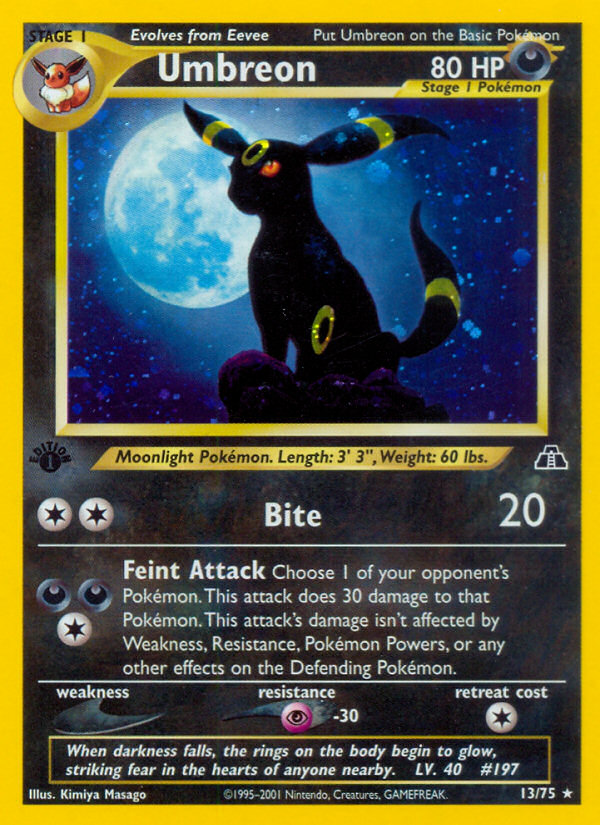
Umbreon — delayed lift
In the 1-to-3-months-after window: +3.4%, barely above market.
In the 3-to-6-months-after window: +16.9%, with a confidence range of +10.6% to +31.4%.
The Eeveelution effect plays out on a longer timescale than the cycle itself.
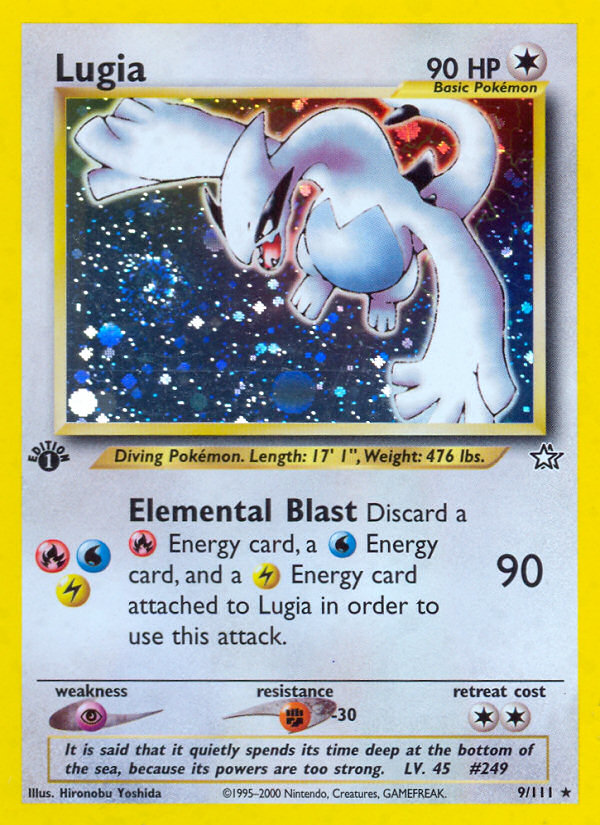
Lugia — falls hard
In the 1-to-3-months-after window: −8.7%.
In the 3-to-6-months-after window: −22.3%, with a confidence range of −34.4% to −11.7%.
Featuring Lugia in a new set has historically been associated with older Lugia cards going DOWN over the following six months. The opposite of the "release lift" assumption.
Why people remember the cycle the wrong way
The pump-fade story is plausible enough that you can find examples that fit it. The mistake is treating those examples as the typical pattern.
Survivorship of the dramatic. People remember Rayquaza pumping pre-release and "fading" because the story is vivid. The hundreds of less dramatic cases that drifted upward quietly don't get talked about.
The fade is mostly the market catching up. In the chart above, the featured line stays above control all the way out, but the GAP narrows by six months. That looks like "fade" if you only watch the featured line. It's really the control catching up.
Different Pokémon, different stories. Most people generalize from the Pokémon they own — often Charizard or another saturated chase — to all featured Pokémon. The per-Pokémon behavior is genuinely different.
How we made sure this wasn't an artifact
This study was designed to try to fail:
- Control group everywhere. Every featured-Pokémon older card is compared against matched non-featured cards of the same era and price band over the same calendar windows. The release-cycle effect is the DIFFERENCE — not the raw move.
- Confidence intervals on every claim. When we say Pikachu lifted +9.4%, we also report the range [+3.7%, +14.1%]. Same for every Pokémon. Readers can judge how confident the data permits us to be.
- Outlier capping. Single-card moves above ±200% per window get clipped. Real moves up to that magnitude pass through; contaminated data points or true freak moves can't dominate the median.
- Minimum sample thresholds. Pokémon with fewer than 5 older cards across events are not reported. Individual events with fewer than 5 price observations in any window are dropped.
- Two independent time horizons. The high-resolution daily sub-study covers 2024–2026. The longer monthly sub-study covers 2021–2026. The findings hold across both.
It was designed to disprove the pump-fade narrative. It couldn't disprove "there's an effect." It also couldn't confirm "there's a fade."
What this does not mean
The findings are strong enough that we don't need to oversell them — so here's the honest fine print:
- It's a tendency, not a guarantee. Pikachu doesn't lift on EVERY release. The +9.4% is the typical case across 296 events. Individual events vary widely.
- It doesn't predict future releases. We measured what happened 2021–2026. The future is not obligated to repeat any historical pattern.
- Smaller per-Pokémon samples are less reliable. Mew at 51 events, Dragonite at 45, Lugia at 39. The point estimates are signal-bearing but the ranges are wide. Read the Pikachu and Charizard findings (300+ events each) as more reliable than the Mew and Lugia ones.
- "Featured" is defined by current PSA-10 chase cards. A Pokémon that has a #5 chase card in a set wouldn't be classed as featured here. Secondary featured Pokémon are not captured.
What it means for actually collecting
- The pump-fade framing is mostly wrong. Older cards of featured Pokémon don't usually fade post-release.
- Per-Pokémon variance is enormous. Pikachu behaves very differently from Charizard from Lugia. Aggregating obscures the real signal.
- The attention market is per-character. Some Pokémon's followings respond to new product; others are so saturated they don't move.
- Most of the action is after release. If there's a release-cycle effect at all for a given Pokémon, it usually plays out in the months after — not before.
Notice what we're not doing here: naming "cards to buy now" or promising a number. The study answers a historical question. It doesn't generate a buy signal.
How TCGinvest uses this
We don't just publish findings — we use them to keep our own projections honest. The platform's long-term projection model is being extended to flag when a card's current price is elevated by release-cycle attention. When that's the case, projections should be read as upper bounds — because the entry price is temporarily inflated by attention that the structural fundamentals don't justify.
The principle is the same as our previous research on mean reversion: the most natural collector instinct is often the inverse of what the data says works.
FAQ
Do old Pokémon cards always pump when a new set features that Pokémon? No. In our 2,008-event study, the aggregate excess lift was about +8.7% in the 1-to-3-months-after window. But the per-Pokémon variance is huge: Pikachu's older cards lifted +9.4% on average, Charizard's didn't lift at all, Lugia's actually fell.
Is the pump-fade pattern real? Mostly no. In aggregate, older cards keep appreciating for at least three months after release — not fading. The "fade" people describe is mostly the control (general market) catching up.
When does the lift actually peak? About 1–3 months after release date, not before. The biggest excess-vs-market gain is in that window.
Why does Charizard not move? The Charizard market is so saturated and so continuously priced-in that incremental Charizard product doesn't move the marginal collector. We can measure the absence; we can't fully explain it from this data alone.
Is this financial advice? No. It's research and education. Past tendencies do not guarantee future results.
See it on real cards, live
The findings aren't just an aggregate — they show up on individual cards. TCGinvest tracks every card with this lens, scores roughly 8,000 of them, and shows the working.
- ▸ Browse Pokémon sets and cards →
- ▸ See the top projected-ROI cards →
- ▸ Track a portfolio with real P&L →
The takeaway
The biggest surprise wasn't that the release cycle moves the market.
It's that the most common framing of how it moves is the opposite of what's true — and the per-Pokémon variance is so large that the cycle itself isn't the right thing to focus on.
Which Pokémon. Which era. Which price band. That's where the actual signal lives.
Read another study

Why The Hottest Pokémon Cards Are Often the Worst Bets…
A point-in-time, survivorship-safe study of 47,431 Pokémon card price histories across five market regimes. Cards that just spiked underperformed; recently-cooled cards outperformed. The data, honestly.
Methodology: 2,008 (Pokémon × set-release) events across 43 sets, 75 featured Pokémon, 1,165 older cards. Daily sub-study: 579 events across 14 sets. Control group: matched non-featured cards of same era and price band. All claims include 90% bootstrap confidence intervals. Data sources: TCGplayer daily prices, PriceCharting PSA-10 monthly prices, PSA population reports, set release metadata. Research and education, not financial advice. Past tendencies do not guarantee future results. TCGinvest is not affiliated with Nintendo, The Pokémon Company, or any TCG publisher.