
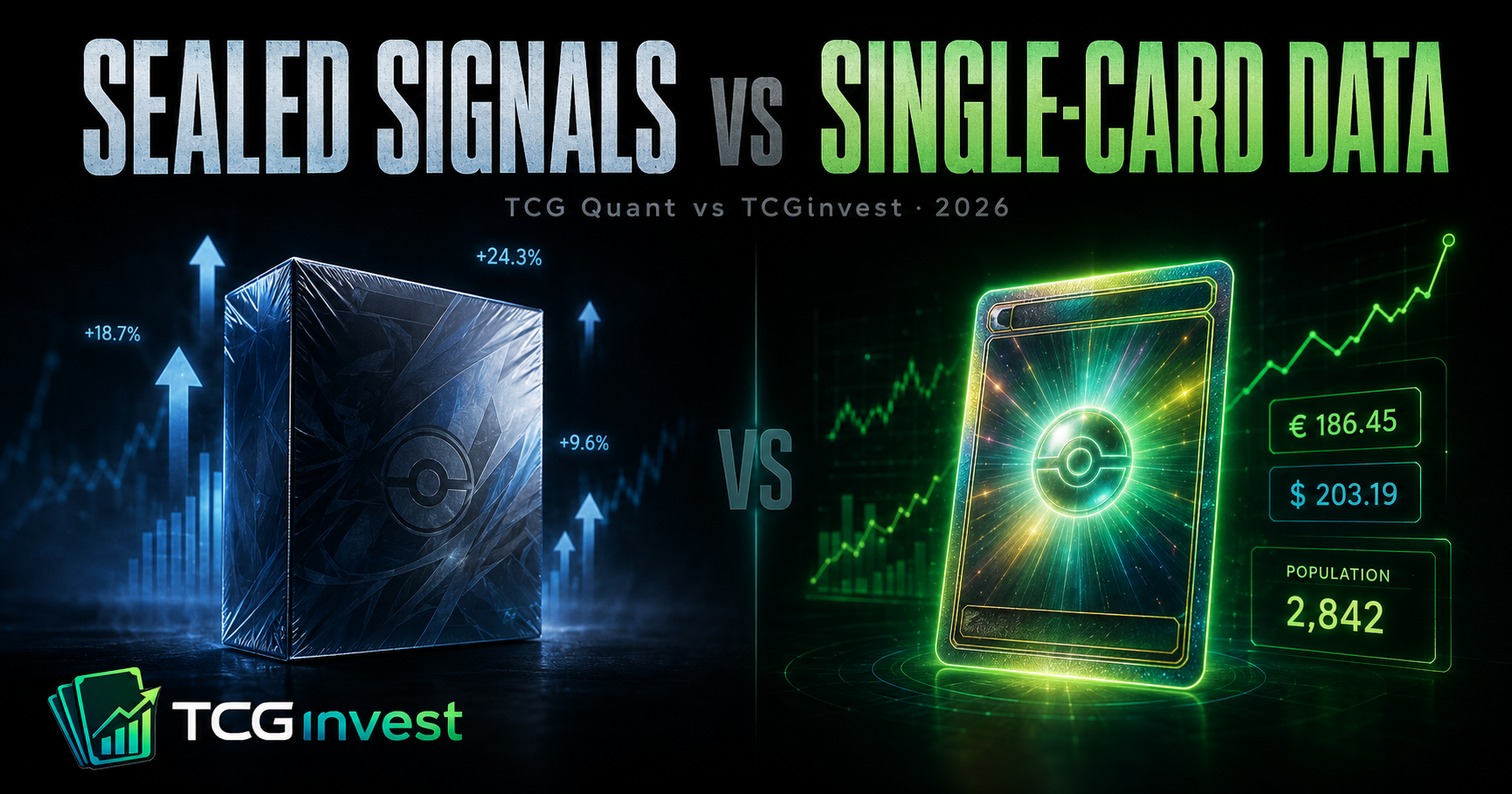
Two tools, two different jobs. TCG Quant (tcgquant.com) is a quantitative buy-signal platform for sealed product: daily BUY SETUP / WATCH / NEUTRAL signals across roughly 142 sealed Pokemon and One Piece products, built from TCGPlayer, eBay and PSA data, at $12.99 a month. TCGinvest (this site) is a single-card data engine: 24,000+ individual Pokemon cards tracked with European (Cardmarket) and US prices, PSA population data, five years of sold-price history and a letter grade per card - and it deliberately does not issue buy calls.
Key differences, up front:
- Coverage: they price ~142 sealed products; we track 24,000+ individual cards. The two barely overlap.
- Output: they publish signals that tell you when to act. We publish measurements and keep every deal flag on a public ledger with its outcome on the record.
- Markets: their data is US-centric (TCGPlayer, eBay, PSA). We treat Cardmarket EUR and US prices as equal citizens on every card page.
- Price: $12.99/mo (theirs) vs free for the full read on any card here, with a $9.99/mo tier for projections, unlimited watchlists and alerts.
- If you buy sealed boxes and want someone to time it for you, that is their pitch, not ours. If you deal in single cards and want the numbers under your own decisions, that is ours.
If you searched "TCG Quant" you are probably evaluating the same question their trial page asks: is a $12.99-a-month sealed-signal subscription worth it? We are not going to answer that for you - it is not our product, and judging a competitor's signal accuracy from outside is not something we can do honestly. What we can do is map what each tool actually covers, because the overlap is far smaller than the similar names suggest, and the right choice depends almost entirely on what you hold.
What TCG Quant is
TCG Quant describes itself as a quantitative platform for sealed TCG product, built by sealed investors, with the tagline "invest with data, not opinions." As published on their homepage in July 2026: daily signals graded BUY SETUP, WATCH or NEUTRAL across about 142 sealed products - Pokemon booster boxes, bundles and Elite Trainer Boxes from the XY through Scarlet & Violet eras plus premium collections, and One Piece sets OP-01 through OP-16. The signals are computed from TCGPlayer, eBay and PSA inputs through a 10-point composite covering things like daily sales rate, inventory days and supply contraction. They publish a headline figure of "81.6% historical accuracy across 402 tracked signals." That figure is theirs; we have not verified it and have no way to, so we simply pass it along attributed.
Pricing is $12.99 a month or $124.99 a year with a 3-day trial. Distribution runs through the founders' YouTube channels, which is why most searches for the name are people who just watched a video and are checking whether the site is legitimate.
Read the coverage list again, though, because it is the single most important fact in this comparison: TCG Quant does not cover single cards. No raw singles, no graded singles, no per-card history. Their universe is sealed boxes.
What TCGinvest is
TCGinvest is built on the opposite premise: the unit of analysis is the individual card, and the output is measurement rather than instruction. In numbers: 24,000+ English Pokemon cards tracked across 240+ sets, each with Cardmarket EUR and US pricing side by side, monthly sold-price history going back five years, real PSA population data, and a composite letter grade (S+ down to D) with the methodology published in full. The grading calculator computes whether slabbing a specific card pays, net of fees, using that card's own PSA population - the analysis that found almost 4 in 5 cards lose money when graded.
On the signals side our stance is deliberately different from theirs: the engine flags listings sitting well below a card's own recent market level, every flag posts to a free Telegram channel, and every flag it has ever produced stays on a public ledger with its entry price and what the market did next - hits and misses alike, uneditable after the fact. We do not grade our own homework with an accuracy percentage; we leave the homework public and let you grade it.
The full read on any card - price, history, sub-scores, population, letter grade - is free. The $9.99/mo tier adds five-year projections, unlimited watchlists, portfolio analytics and real-time alerts.
Side by side
| TCG Quant | TCGinvest | |
|---|---|---|
| Universe | ~142 sealed products (Pokemon + One Piece) | 24,000+ single Pokemon cards |
| Output | Daily buy signals (BUY SETUP / WATCH / NEUTRAL) | Measurements, letter grades, deal flags with a public outcome ledger |
| Single cards | No | Yes - raw and PSA graded, per-card history |
| Sealed product | Yes - their entire focus | Price data pages only, no sealed signals |
| Markets | US (TCGPlayer, eBay, PSA) | EU (Cardmarket EUR) + US, side by side |
| Track record | "81.6% accuracy over 402 signals" (their published claim) | Every signal public on the ledger with its outcome |
| Grading math | "Destruction Tracker" (PSA impact) | Grade-or-sell EV per card from real PSA populations, net of fees |
| Price | $12.99/mo · $124.99/yr | Free tier · Pro $9.99/mo |
Where each tool fits
The honest split is by what you actually hold and how you want to decide.
TCG Quant fits a US-based sealed collector who wants timing calls delivered - someone holding or hunting booster boxes and ETBs who is comfortable outsourcing the "when" to a signal engine and paying for the service. Our own raw vs graded vs sealed study found sealed was the strongest-holding format of the last five years, so the interest in sealed-focused tooling is not misplaced.
TCGinvest fits anyone whose money is in single cards - raw or slabbed, EU or US - and who wants the numbers underneath their own decisions rather than a call to follow. If you are deciding between two Charizards, checking what a card's rarity or era has historically meant for holding value, weighing whether to grade, or watching for a specific card to trade below its own market level, that is the job this site was built for.
And plainly: plenty of collectors hold both sealed boxes and singles. The tools do not conflict, because they barely overlap.
What this comparison does not say
- It does not say their signals are wrong. We have not tested them and cannot. Their accuracy figure is their published claim, reproduced here with attribution and nothing more.
- It does not say sealed is the wrong asset. Our own published data says the opposite about the last five years.
- It is not neutral territory. This comparison lives on TCGinvest, written by us. We have kept it to verifiable coverage facts and each side's published claims precisely because of that.
FAQ
Is TCG Quant an alternative to TCGinvest? Only partially. TCG Quant covers roughly 142 sealed products with buy signals; TCGinvest covers 24,000+ individual cards with data and no buy calls. If your money is in singles, their tool does not address it; if you want sealed timing signals, ours does not do that.
Does TCGinvest cover sealed product? We publish sealed price data pages, and our research covers sealed performance in depth, but we do not issue sealed buy signals or score sealed products. Our published position is data-first there.
Is TCG Quant legitimate? We have no relationship with them and no basis to judge beyond what is public: a live product, published pricing, and founders who are known TCG YouTubers. The accuracy claim on their homepage is theirs to defend; we neither endorse nor dispute it.
Why does TCGinvest not publish an accuracy percentage for its own signals? Because we publish the entire record instead. Every signal ever posted sits on the ledger with its entry price and outcome, public and uneditable. A single percentage summarizes; a ledger lets you check.
Which is cheaper? Their premium is $12.99/mo or $124.99/yr after a 3-day trial. TCGinvest's card data, scores, history and population data are free; Pro (projections, unlimited watchlist, alerts) is $9.99/mo.
Where this leaves a reader
If you arrived here from a "TCG Quant review" search, the practical summary is short: they sell timing signals for sealed boxes, we measure single cards and show our work. Decide based on where your money actually sits. If it sits in singles, start where the data is free: any card page shows the full read, the grading calculator will tell you if slabbing a specific card pays, and the signals ledger shows every flag we have ever raised, with the outcomes attached, which is where we prefer our claims to live.