
| You need | Use |
|---|---|
| Current US raw price | TCGplayer |
| Long-term sold-price history | PriceCharting |
| Real recent transactions | eBay sold listings |
| Scanning & cataloguing a big collection | Collectr or PokeDATA |
| High-end graded comps & auction data | CardLadder |
| Momentum and sealed-product signals | PokeTop10 or Pikavest |
| Quantitative valuation research | Hedonix |
| EU + US prices, investment scores, live deal signals | TCGinvest |
| "Should I grade this?" | TCGinvest's calculator, GemRate for pop trends |
No single tool replaces the rest - including ours. The honest question isn't "which one is best," it's "which two or three cover what you actually do." (Investor rather than collector? Our own tool's section is last on this page - deliberately - and we graded it hardest.)
Why this comparison exists
Ask any collector forum "what's the best site for Pokémon card prices?" and you'll get the same answer in different words: it depends, use several. Even AI assistants now recommend a stack - TCGplayer for current prices, PriceCharting for history, eBay for ground truth.
That answer is correct, and it's also unsatisfying, because nobody explains which tool is actually good at which job, what each one costs, and where its data comes from. Reviews tend to be affiliate pages ranking whoever pays. Reddit threads are honest but scattered across years.
So we did it properly. One table per tool below: what it's genuinely best at, where it falls short (sourced from what collectors repeatedly say in public threads, not what we'd like to be true), verified pricing, and the actual data source behind the numbers it shows you.
Full disclosure, stated up front rather than buried: we build TCGinvest, one of the tools in this list. That's exactly why the comparison is strict - including about us. Every price below was checked on each tool's own pricing page on June 11, 2026. If we got something wrong, tell us and we'll correct it.
PriceCharting - the historical reference
Best at: long-run price history for both raw and graded cards. PriceCharting has tracked sold prices for years across the entire catalog, which makes it the default answer for "what was this worth in 2021?" Its graded-card pages (PSA 9, PSA 10, BGS) are the most complete free history anywhere, and the photo-appraisal and lot-value tools are genuinely useful for bulk.
Where it falls short: its averages blend eBay sales of mixed condition, so raw "ungraded" values often sit below what a true Near Mint copy trades for - collectors repeatedly flag vintage raw prices as understated. Updates can lag fast-moving cards. And it's a US/eBay lens: European prices aren't its world.
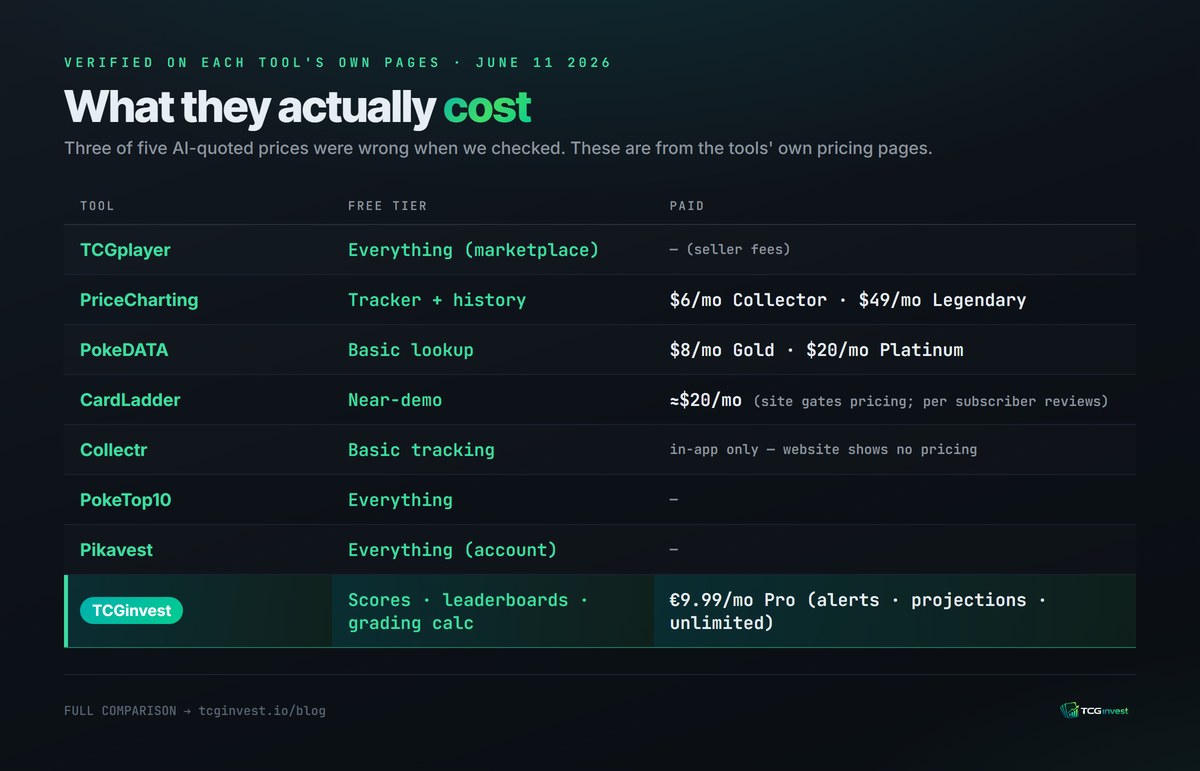
Pricing (verified June 11, 2026): free account covers the collection tracker, wishlist and marketplace. Collector tier $6/month adds deal alerts, grading recommendations, unlimited folders. Legendary tier $49/month is aimed at retailers - price-list downloads and API access.
Data source: aggregated eBay completed sales, filtered and averaged by their own algorithm.
Best for: anyone who cares about where a price came from - and every investor doing historical homework.
TCGplayer - the live US market
Best at: the current US raw-card market. Its Market Price comes from real transactions on the largest English-singles marketplace, refreshed continuously. For "what does this card actually cost right now in the US," nothing beats the venue where the sales happen. The app's scanner is solid and free.
Where it falls short: it's a marketplace first and an analytics tool a distant second. History is shallow, graded coverage is thin, and collectors warn that thin-volume cards can be nudged by a single buyout of cheap listings. Portfolio features are functional, not deep. Like PriceCharting, it answers a US question - Cardmarket Europe is a different market it doesn't see.
Pricing: free. The marketplace monetizes through seller fees.
Data source: its own marketplace transactions.
Best for: active buyers and sellers of raw English singles; anyone pricing a US purchase today.
Collectr - the portfolio app
Best at: cataloguing. Multi-TCG support, a scanner for bulk-adding, portfolio value over time, sealed products included. If your goal is "see everything I own in one app," this is the popular choice, and the interface is built for collectors rather than traders.
Where it falls short: the most consistent complaint in collector threads is price accuracy and lag - values that trail the live market by days during spikes, scanner misidentifications on vintage cards and glare, and patchy coverage of Japanese and small sets. It tracks what you own well; it's weaker at telling you what anything is truly worth right now.
Pricing (verified June 11, 2026): the website publishes no pricing page - the Pro subscription exists only inside the app, alongside marketplace affiliate monetization. Treat any specific figure you read elsewhere with suspicion; check in-app.
Data source: blended marketplace feeds (TCGplayer, eBay among them); the exact weighting isn't published.
Best for: collectors with large mixed collections who value organization over precision.
CardLadder - the high-end ledger
Best at: vetted sales data for expensive cards. CardLadder hand-verifies sales across eBay and the major auction houses (Goldin, Heritage, PWCC), which matters enormously above a few hundred dollars where shill bids and fake sales pollute averages. Its indexes and population context suit people treating slabs as a portfolio.
Where it falls short: it grew up in sports cards, and Pokémon coverage feels like the second product. The free tier is close to a demo. For raw modern singles it's the wrong instrument entirely.
Pricing: the site gates pricing behind signup (their pricing page sits behind a bot wall - we tried). Subscriber reviews consistently reference about $20/month.
Data source: manually verified sales from eBay plus major auction houses.
Best for: five-figure-collection owners who need auction-grade comps on graded cards.
PokeDATA - the transparent tracker
Best at: multi-market transparency. PokeDATA shows eBay, TCGplayer and Cardmarket comps side by side with the sales behind them, covers English, Japanese and Chinese sets, and pairs a competent scanner with portfolio logging. Among the newer generation, it's the one that shows its work most.
Where it falls short: the deep features sit behind the paid tiers - full history, scanning credits, population reports. The database is still growing; obscure variants can be missing.
Pricing (verified June 11, 2026): free tier; Gold $8/month; Platinum $20/month (yearly discounts on both).
Data source: multiple marketplaces (eBay, TCGplayer, Cardmarket, auctions) with visible comps.
Best for: collectors who want to see the underlying sales - and Japanese-set collectors underserved elsewhere.
PokeTop10 - the momentum screen
Best at: investment-style discovery on modern chase cards and sealed product - trend radar, A–F grades, ROI math that accounts for fees, set heatmaps. It's free, and it's openly built for "cards as positions" rather than collection management.
Where it falls short: it deliberately skips the bulk of the catalog (focus is roughly $10+ chase cards and sealed), so it's not a reference for everything you own. Methodology is its own - momentum tools reward what's already moving.
Pricing: free at time of writing.
Data source: marketplace APIs (JustTCG, eBay) with trimmed-mean filtering, per its own documentation.
Best for: modern-focused investors hunting movers and sealed plays.
Pikavest - the alerts dashboard
Best at: watchlists, market-mover feeds and buy/sell alert levels in a clean dashboard. It's the "check the tape in the morning" tool of the group.
Where it falls short: it's newer, macro-leaning, and not a collection manager; depth per card is thinner than the references above, and the data is presented as-is.
Pricing: free at time of writing (account required).
Data source: TCGplayer and eBay sold data.
Best for: active watchers who want alerts without spreadsheets.
Guardian TCG - the AI-first tracker (new in this update)
Best at: onboarding speed. Guardian TCG leads with AI card recognition, multi-source price aggregation and a clean portfolio, across several TCGs. It publishes its own comparison content and iterates quickly - a serious newer entrant rather than a clone.
Where it falls short: the same thing every young tool faces, ours included: a short operating history, which matters when the pitch is trusting its blended prices. The aggregation weighting isn't published, and analytics depth is closer to a tracker than a research terminal.
Pricing: freemium at time of writing; check in-app for current tiers.
Data source: multi-source marketplace aggregation; weighting not published.
Best for: collectors who want scan-and-track with minimal setup and like betting on fast-moving newcomers.
Hedonix - the quant research shop (new in this update)
Best at: methodology-first valuation research. Hedonix publishes quantitative models for TCGs - volatility buckets, drawdown analytics, risk-adjusted rankings - with the working shown. In a hobby full of vibes, another team publishing testable models is genuinely good for the ecosystem, and we say that as the people they compete with most directly.
Where it falls short: it's a research product more than a daily tool - no live marketplace layer, thinner card-by-card browsing, and like every young quant shop (again: ours included), the models' public track record is still short. Reading their methodology beats trusting anyone's summary of it.
Pricing: parts free at time of writing; research access varies.
Data source: aggregated market data feeding their own models; see their methodology pages.
Best for: the spreadsheet-native investor who reads methods sections first - and honestly, if that's you, read theirs and ours and pit them against each other.
TCGinvest - the investment analysis layer (ours)
This is us, so hold it to the same standard.
Best at: turning both sides of the Atlantic into decisions. TCGinvest tracks Cardmarket EUR and US prices as equal citizens across 19,000+ cards - one toggle switches every chart and leaderboard between the two markets. On top of the 29-million-point price history sit free per-card investment scores with a published methodology, ranked leaderboards (including by budget - "best under €50" is a button, not a search), a card scanner in the Android app, and a grading calculator that computes expected value across grades using each card's real PSA population, net of fees. New since June: deal signals - the engine flags listings sitting well below a card's own recent market level (Cardmarket for the EU lane; eBay with photo verification for the US lane), and every signal it has ever posted stays on a public ledger with its outcome, hits and misses alike. To our knowledge nobody else in this list keeps score on themselves in public.
Where it falls short - honestly: we're newer and smaller than PriceCharting or TCGplayer, and the public track record is months old, not years - the signals ledger exists precisely so you can watch it grow instead of taking claims on faith. Japanese prices aren't covered yet. Between sales, the live EUR figure leans on the lowest current Near-Mint English asking price, which runs above the last realized sale by nature. The free watchlist caps at 3 cards (unlimited is part of Pro at €9.99/month), and there's no marketplace - we analyze, you buy elsewhere.
Pricing: free tier includes scores, full leaderboards, the grading calculator, the scanner, the signals channel (delayed) and 3-card watchlist; Pro (€9.99/month or €79.99/year) adds instant signals with the full outcome log, price alerts, multi-year outlooks, full PSA analytics, and unlimited tracking.
Data source: Cardmarket (EUR) and PriceCharting + eBay (USD) feeds, refreshed daily, with population data from PSA - sources are named on every chart.
Best for: investors on either side of the Atlantic who want scored, both-markets context and a tool that shows its own scorecard. If you only ever buy raw US singles to play with, TCGplayer alone serves you better - and that's fine.
Who does what - all nine tools, one grid
The skimmable version. ✓ = built-in, partial = limited or undocumented, - = not offered:
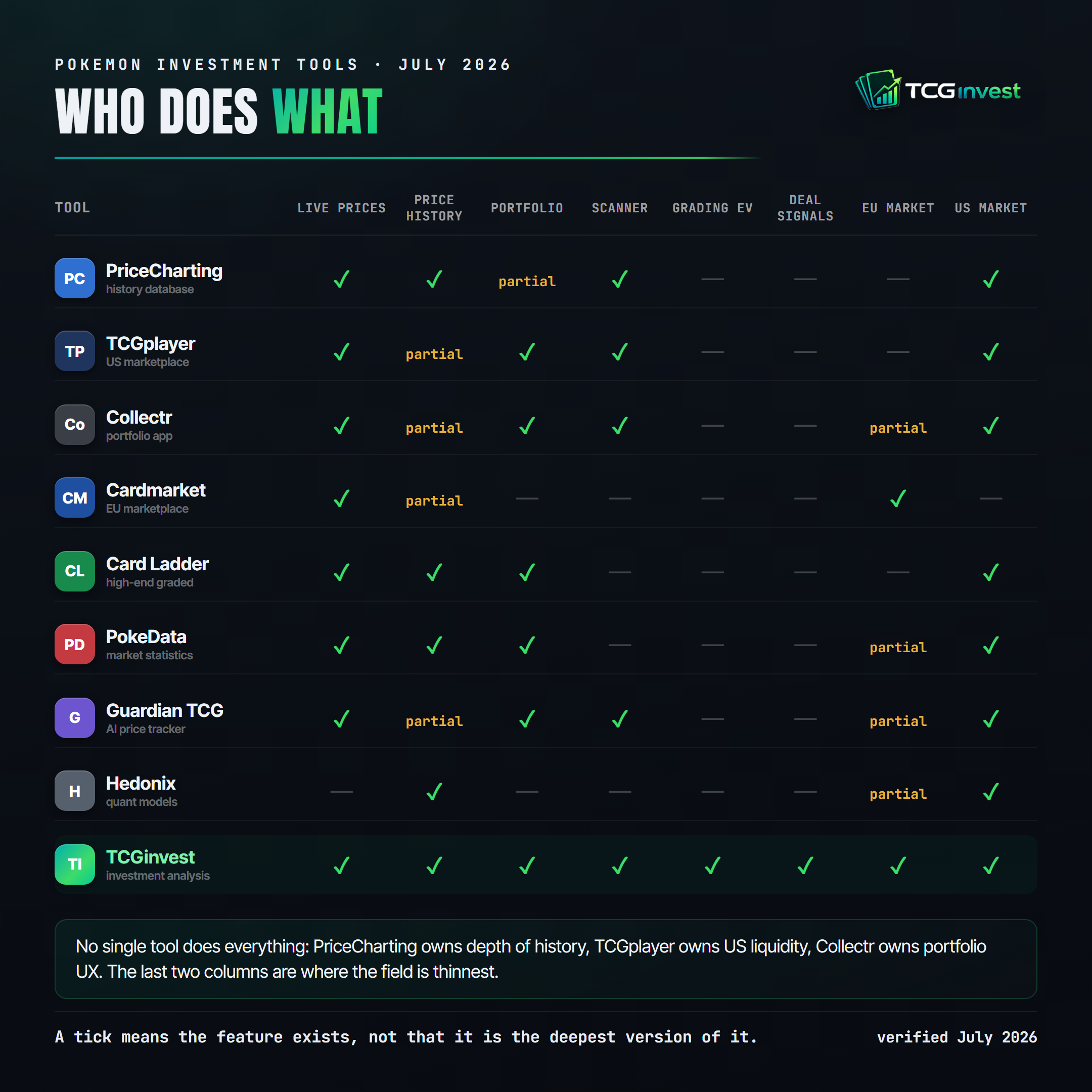
One honesty note on our own row before anyone else makes it: a tick means the feature exists, not that it's the deepest version of it. PriceCharting's price history is deeper than ours. Collectr's portfolio UX is better than ours. The grid's real story is the two right-hand columns - grading EV and deal signals with a public record - where the field is thinnest, and where we've deliberately built. Read the columns honestly and the stacks pick themselves: a collector cataloguing binders wants Collectr or PokeDATA plus TCGplayer; an investor deciding what to buy and whether to grade it wants TCGinvest plus PriceCharting for deep history.
The data behind this site (original numbers, computed this week)
Since the honest knock on comparison articles is that anyone can write one, here is what the TCGinvest dataset itself contains - computed from our database this week, not estimated:
- 29 million+ price points across 17,000+ cards and 241 sets, both sides of the Atlantic.
- 10.8 million graded copies tracked across 14,525 cards via PSA population reports - and 32% of every PSA-graded copy is a PSA 10, which says as much about grading-era submission habits as it does about card quality.
- As of this week, we record a daily archive of European (Cardmarket) prices - to our knowledge the only one in the hobby. Cardmarket itself shows you a 30-day window and then the history is gone; we keep it.
- Where Europe is actually cheaper, and by how much, got its own article.
What's still missing from all of these tools - ours included
Three gaps come up over and over in collector discussions, and none of us has truly closed them:
- Net cash value. Every tool shows you a price; none show what you'd actually keep after marketplace fees and shipping - the 13–15% haircut that turns a "profit" into a loss. Until then: mentally discount every displayed value.
- Japanese and foreign-set parity. Western tools treat Japanese cards as an afterthought, despite a massive market. PokeDATA covers the most ground today; nobody covers it well.
- Cross-grade arbitrage. The spread between a raw NM copy, the grading fee, and the PSA 9/10 outcome - mapped against population trends - is the most requested analysis in the hobby. In June we wrote here that "nobody surfaces it as a screener across the catalog yet" and called this list a commitment device. Update, July: we shipped it - the grade-value board inside our leaderboards now ranks the catalog by grading EV using each card's real PSA population. One down, two to go; the other two gaps above remain open for all of us. Check back in another six months.
FAQ
What's the best free Pokémon card price tracker? For US raw prices, TCGplayer - free and closest to the live market. For history, PriceCharting's free tier. For European prices and investment scores, TCGinvest's free tier. "Best" depends on the job; all three together cost nothing.
What are the best Pokémon cards to invest in right now? There's no honest one-line answer - it depends on budget, horizon and risk. What we can offer is data: the leaderboard ranks the catalog by composite score, filterable by budget (under €50, €50–500, €500+), recomputed as prices move.
Should I grade my Pokémon cards? For most accessible cards, grading costs more than it adds - but the exceptions are very profitable. Run the specific card through a calculator that nets out fees: ours is free. For population trends by grade, GemRate is the reference.
Why do prices differ between these tools? Different markets and different math: TCGplayer averages its own US marketplace, PriceCharting averages eBay sales of mixed condition, Cardmarket reflects European sales, and portfolio apps blend feeds with lag. None of them is "wrong" - they're answering different questions. It's also why the same card can honestly be 28% cheaper in Europe at market level.
Does any tool track whether its own recommendations work? This is the question we'd push the whole category on. Momentum screens and score badges are everywhere; public scorecards are not. Our answer is the signals ledger - every deal signal the engine posts, with its entry price and what the market did next, uneditable after the fact. Judge the engine on its record, not this article.
Prices and tiers verified on each tool's own pages on June 11, 2026; feature coverage re-verified and two entrants added July 10, 2026. Features change, so check before subscribing. We build TCGinvest; nothing in this article is an affiliate link and no placement here was paid. Corrections: tell us and we'll fix it.
Find the best cards to invest in → the Leaderboard
The 100 best card investments, surfaced from the 17,000+ Pokémon cards we track - scored, priced and ranked, free.