We took every card we track with a complete graded-sales history — the raw card and its real PSA 7, 8, 9 and 10 sold prices, about 2,950 cards and variants — and ran the only question that matters: if you mail it to PSA, do you come out ahead? Not "could you hit a 10," but the realistic mix of grades you'll actually get, priced at what they actually sell for, minus the fee. The answer is not what the hobby tells you, and the dividing line is not the one everyone assumes.
Everyone grades. Almost no one does the math.
"Get it slabbed, the grade pays for itself" is the most repeated advice in the hobby. It made sense once. Grading used to be reserved for genuinely scarce, genuinely expensive cards, and a PSA 10 was a real event.
Then, sometime after 2021 — carried over from sports and sneakers — collectors started grading everything. Bulk submissions, $3 commons, modern chase cards the week they dropped. The behaviour is new; the assumption that grading "pays for itself" is older, and it quietly stopped being true for most of what people send in.
The grading reflex — and the jam it created
This isn't a niche service anymore. Collectors graded a record 26 million-plus cards in 2025 — up about a third in a single year — and PSA alone slabbed 19.3 million of them, roughly three of every four. At $15-and-up a card, PSA's grading fees run well into the hundreds of millions of dollars a year; the 10.2 million graded Pokémon we counted are just one corner of it.
And the machine is now jammed. By mid-2026 PSA's active backlog was closing on 10 million cards, so it paused its cheaper "Value" tiers outright and stretched regular-service turnaround to 40–60 days. Grading a modern card today means paying the fee and then watching your capital sit in a months-long queue while the hype you were chasing cools. The fee was never the only cost — and the wait just got longer.
So we checked whether the reflex pays. For every card with a complete graded-sales record, we computed the expected value of grading: the realistic chance of each outcome (you usually pull a 9, sometimes an 8, occasionally a 10), each priced at its real sold median, minus a ~$25 all-in grading cost and the ~13% it costs to sell. Positive means grading adds money. Negative means the slab is worth less than what you paid to get it. It's the same calculation we now show on every card page.
It loses money in every era
Start with the breakdown everyone expects — by era. The surprise is that there's no era where grading is a good idea on the typical card:
| Era | Years | Median raw | Cards that lose money to grade |
|---|---|---|---|
| WOTC | 1999–2003 | $60 | 63% |
| EX | 2003–2007 | $26 | 79% |
| DP / HGSS | 2007–2011 | $20 | 79% |
| BW / XY | 2011–2017 | $27 | 66% |
| SM | 2017–2020 | $21 | 98% |
| SWSH | 2020–2023 | $21 | 99% |
| SV | 2023–now | $21 | 99% |
The hobby's instinct — "modern is bad, but grade your vintage" — is only half right. Modern is brutal: 99% of cards printed since 2020 lose money the moment they're graded. But vintage isn't the safe haven people think. Sixty-three percent of WOTC and 79% of EX-era cards lose money too.
It's not the era. It's the price.
Look again at that table — not at the eras, at the median raw price column. WOTC loses the least (63%) and has the highest median raw ($60). Everything else clusters around $20 raw and loses 66–99%. The era isn't driving the result. The price is. Sort the same cards by raw value instead and the pattern is razor-clean:
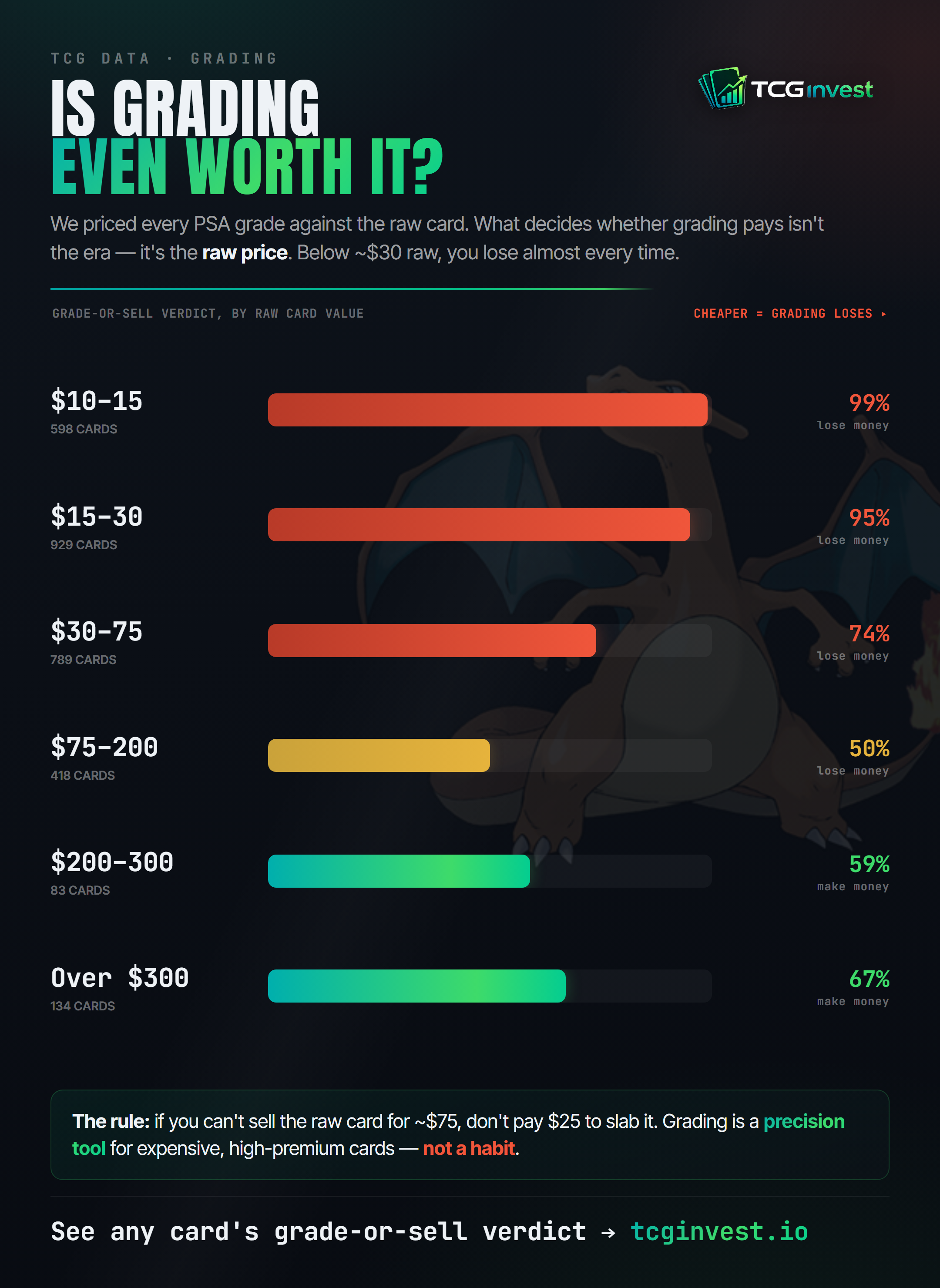
| Raw card value | Cards that lose money to grade |
|---|---|
| $10 – $15 | 99% |
| $15 – $30 | 95% |
| $30 – $75 | 74% |
| $75 – $200 | 50% |
| $200 – $300 | 41% |
| Over $300 | 33% |
There's the whole story in one column. The median card we'd tell you to grade is worth $86 raw; the median card we'd tell you to sell is worth $22. Grading is a roughly fixed ~$25 cost, and a fixed cost is a tax that only a high-value card can absorb. Modern cards lose not because they're modern, but because they're cheap — and cheap vintage loses for exactly the same reason.
"But I'm a good grader"
The usual defence is "I hit 10s." Fine — we tested precisely that, cranking the PSA-10 hit rate on modern cards from realistic to absurd. Here's the share that still loses money:
Even if you gemmed half of everything you touched — a rate no submitter on earth sustains — roughly half of modern cards would still be a loss. The problem was never your eye for centering. A fixed fee on a cheap card is a losing trade no matter how good you are.
The cards people most want to grade are the ones they shouldn't
Here's the trap closing: the cards collectors most want to slab — this year's chase cards — are exactly the ones the math rejects, and being expensive doesn't save them.
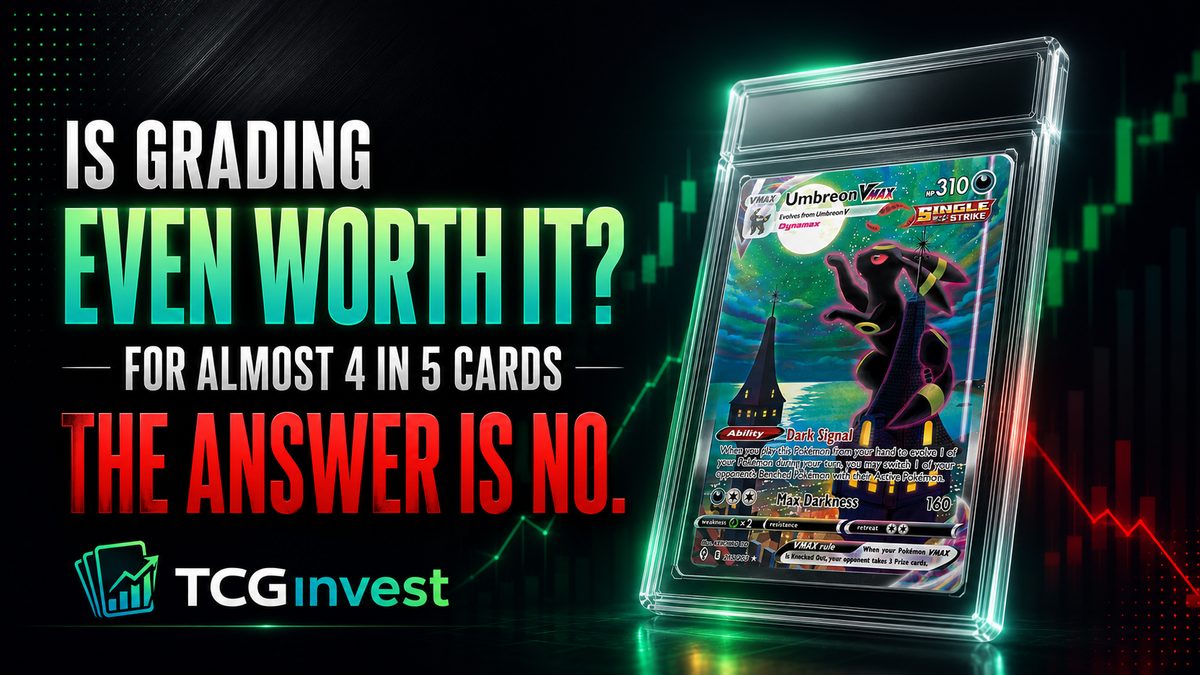
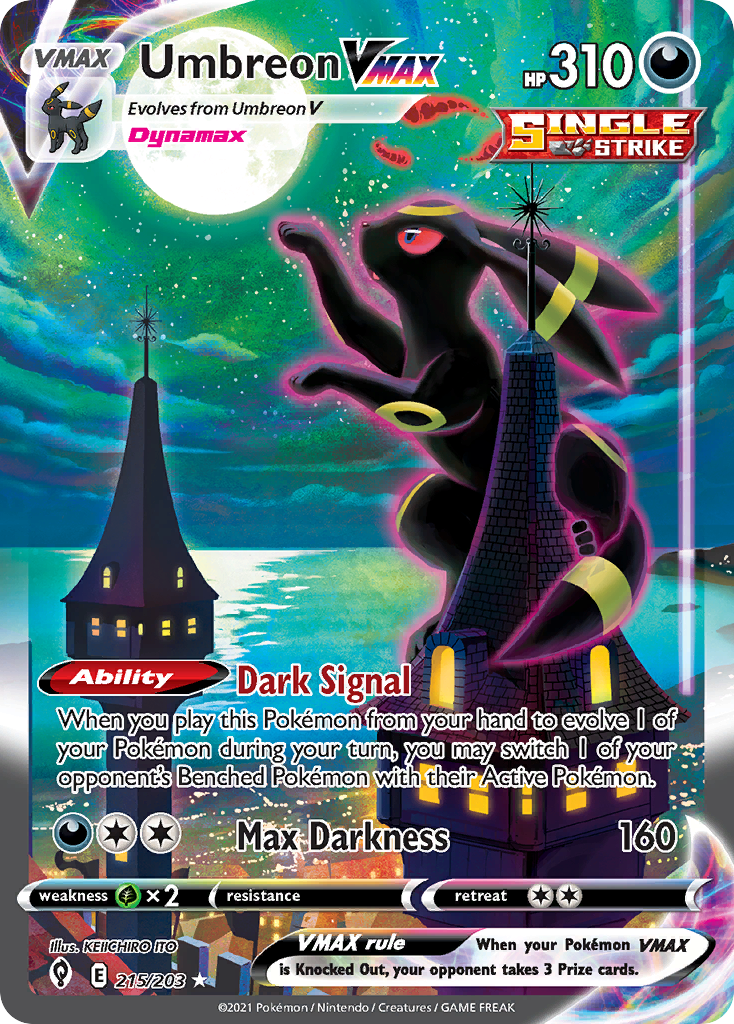 The Evolving Skies "Moonbreon" — one of the most-submitted modern cards in the hobby. It costs $1,700+ raw, and grading it still loses money.
- Umbreon VMAX (Moonbreon) — ~$1,720 raw, and grading it comes out −$380. It's an expensive card, but the PSA 10 sells for only ~88% over raw, and you usually pull a 9. High raw price, thin premium — a loss.
- Mew ex (Paldean Fates) — −$249.
- Umbreon ex (Prismatic Evolutions) — −$209.
- Charizard ex (Obsidian Flames) — even at ~$110 raw, −$44.
These aren't $3 commons. They're some of the most-graded modern cards in existence, and raw-and-sold beats graded-and-waited on every one. A high price tag is necessary for grading to pay — but it isn't sufficient. You also need a fat PSA 10 premium, and modern chase cards don't have one.
Where grading still genuinely pays
It does pay — on a narrow, specific kind of card: expensive, vintage, and hard enough to gem that the PSA 10 commands a real multiple. These are live numbers from our own card pages:
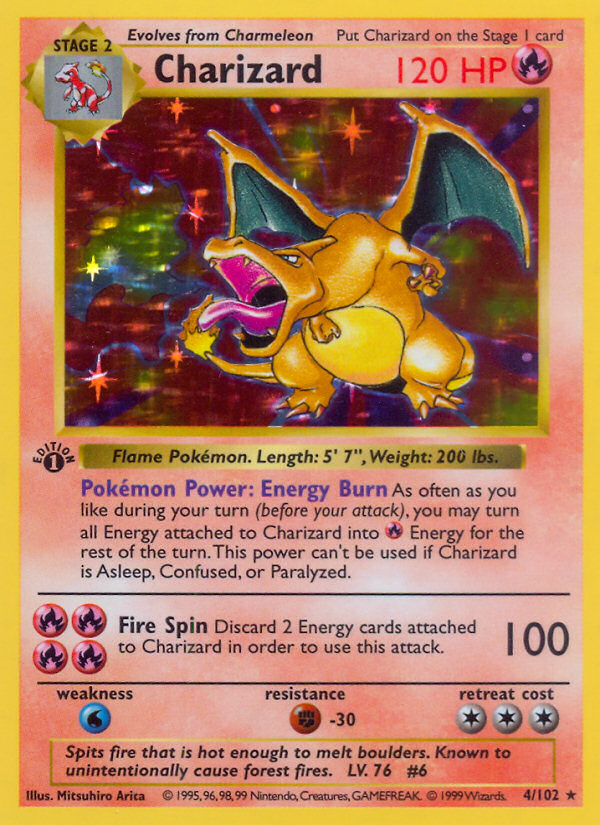 A 1999 Base Set Charizard: expensive raw, brutally hard to gem, and the PSA 10 sells for ~19× the raw card. The grading trade works here.
- Base Set Charizard (1999) — ~$810 raw, PSA 10 ~$15,700. Expected grading value: +$1,601.
- Lugia (Aquapolis, 2003) — ~$1,440 raw, PSA 10 ~$14,600. Expected value: +$2,542.
- Espeon ex (Unseen Forces, 2005) — ~$325 raw, PSA 10 ~$6,500. Expected value: +$691.
The common thread isn't the year on the card. It's that each one is expensive raw and carries a PSA 10 premium of many multiples — the two conditions grading actually needs.
The one rule that replaces every population report
Forget gem rates and pop reports. The single best predictor of whether grading pays is the raw price of the card in your hand:
- Under ~$30 raw: grading is almost always a loss (95–99%). The fee alone eats the premium. Sell raw.
- $30 – $75 raw: still a loss about three times in four. Default to selling raw unless the PSA 10 multiple is exceptional.
- Over ~$200 raw, with a fat PSA 10 premium: now the odds finally favour you. This is the narrow band where grading earns its fee.
What it means if you're investing
The takeaway isn't "never grade." It's that grading is a trade with a cost, not a free value-up — and the hobby's default advice has the sign backwards for most of what's in your binder:
- Grading is concentrated alpha, not a broad strategy. It pays on expensive, high-premium cards — overwhelmingly old trophies — and loses on almost everything else, vintage or modern. Treat it as a precision tool, not a habit.
- The raw price is your gate, not the era. Under ~$75 raw, default to selling raw. The flat fee, the months of wait, and the near-certain 9 do the rest.
- A high price tag isn't a green light. Moonbreon is a $1,700 card that still loses to grade. You need raw value and a real PSA 10 premium — check both before you mail anything.
And one honest caveat, because it changes the math: this is PSA only. CGC, BGS and TAG carry different fees, turnaround, and market premiums — enough to move some of these numbers. That's the next breakdown.
We compute the grade-or-sell math for every card across every set — raw value, the realistic graded outcome, and whether the slab actually adds money. The card you were about to send to PSA might be worth more raw, and it takes one search to find out. Free account, any card.
Methodology: PriceCharting 180-day sold medians for raw Near-Mint and PSA grades 7–10, across the ~2,950 cards and variants in our database with a complete graded-sales record (raw NM ≥ $10, valid PSA-10 sale). Expected grading value = a realistic outcome mix (≈5% PSA 10, 40% PSA 9, 35% PSA 8, 15% PSA 7, 5% lower) priced at real sold medians, net of a ~$25 all-in grading cost and a 13% sale fee — the identical calculation shown on every card page. The gem-rate sensitivity re-runs the same math at PSA-10 hit rates from 5% to 45%. "Lose money" means the expected graded value is below the raw card's value plus the cost to grade. PSA only; other graders not included.