We took every PSA-graded Pokémon card in our database and grouped them by character — not by set, not by individual card, by the Pokémon itself. That's 10,184,623 gradings spanning the card game's history. One name dominates so completely it changes how you should read the word "popular."
Popularity, finally counted
"Most popular Pokémon" is a phrase everyone uses and almost no one measures. There is one rigorous version of it, and it has been sitting in plain sight: grading population — every card a collector valued enough to send to PSA, all the way back to Base Set.
It isn't a flawless popularity metric. But it is cumulative, it spans the entire history of the game, and it is brutally honest about what people actually care to preserve. We grouped all 10.2 million of them by character.
Here is what they say.
The most graded Pokémon of all time
It isn't a ranking. It's a monarchy.
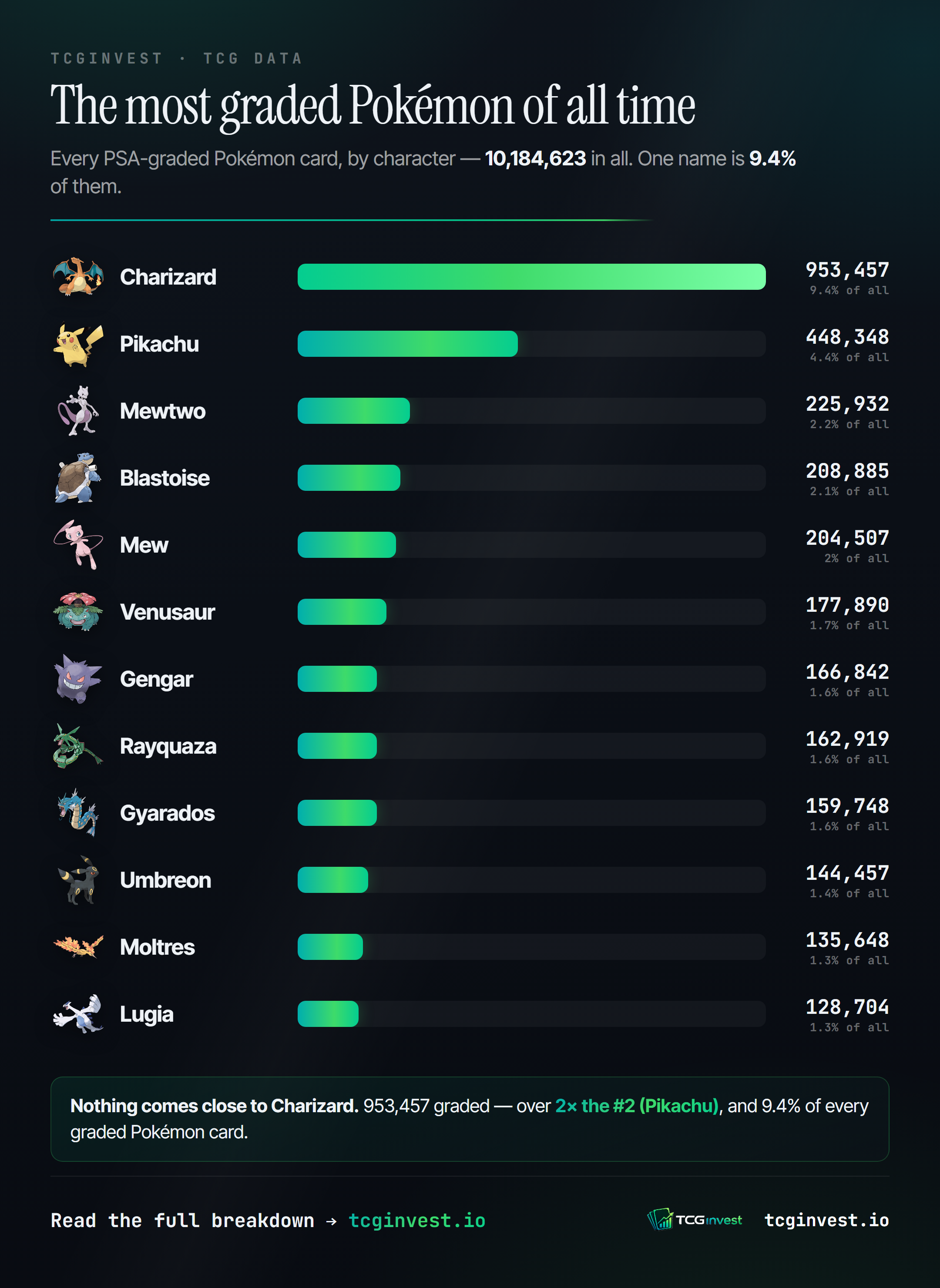
Charizard is 9.4% of every graded Pokémon card in existence — 953,457 of them. That is more than double Pikachu, the #2 at 448,348, and more than Mewtwo, Blastoise, Mew and Venusaur — the #3 through #6 — put together.
No other character clears even 5% of the total. Nine of the top twelve are Gen 1 — the 1999 originals. The only three to break the wall are Rayquaza (#8), Umbreon (#10) and Lugia (#12), and even they are two decades old. This board was set a long time ago.
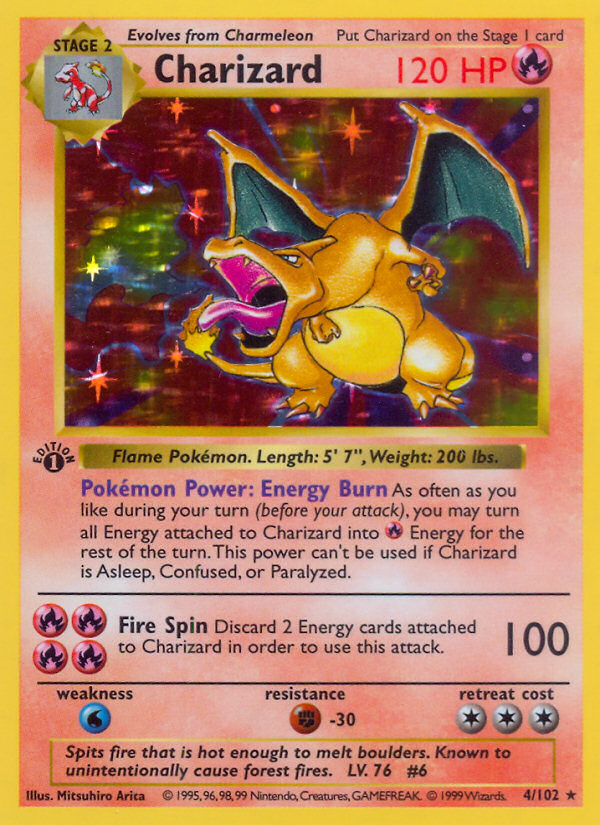 The 1999 Base Set Charizard — the card that started the obsession, and the most-graded Pokémon's most-graded face.
"Most graded" is not "most valuable"
Here's where it stops being trivia and starts being useful to anyone treating cards as an asset.
Grading population tells you what people collect. It tells you nothing about what holds value. Rank the same characters instead by the combined price of their five most expensive cards, and the board reshuffles — with a punchline:
Magikarp — the useless splashing fish, the running joke of the entire franchise — carries the second-highest high-end value of any Pokémon, while being graded roughly 12 times less than Charizard. One Shining Magikarp does what a million graded commons cannot.
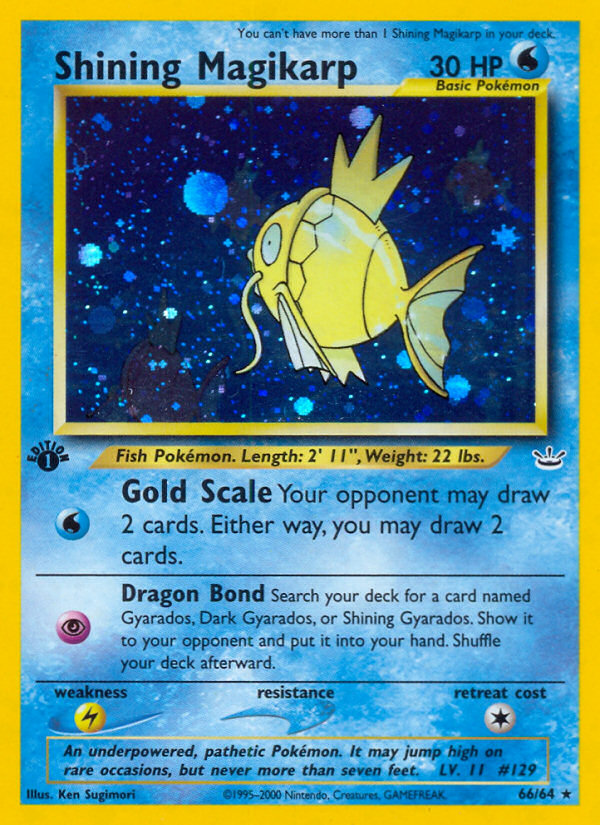 Shining Magikarp, Neo Revelation 2001 — one rare print carries the entire species' high-end value.
It runs the other way, too. Look at the Pokémon that get graded constantly but carry almost no high-end value:
- Moltres — 135,648 graded, best cards under $700
- Reshiram — 124,532 graded, under $850
- Machamp — 118,023 graded, under $700
These are bulk-graded Pokémon. People slab them by the thousand, which inflates the population, which makes the character look white-hot — while the best cards stay cheap, precisely because the graded supply is bottomless.
What it means if you're investing
The lesson isn't "buy Charizard" or "avoid Moltres." It's structural, and it's the whole reason a popularity list and a performance list are different documents:
- A Pokémon being beloved (high population) is necessary for its cards to hold value — and nowhere near sufficient. Charizard, Magikarp and Moltres are all beloved. Their cards behave nothing alike.
- The cards that compound are the ones where demand is high and the specific print is scarce — a Shining Magikarp, a Gold Star, a 1999 holo whose graded population isn't endless. Not simply "a card of a popular Pokémon."
- Grading population is a lagging, cumulative figure. A Pokémon graded 100,000 times is telling you about the last twenty-five years — not the next five.
We don't tell you what to buy. We measure which cards the market actually rewards. "Most popular character" and "best card to own" are, demonstrably, two different answers.
How far the data really goes
A number is only as good as its honesty about its own limits — so here is exactly what is trackable today, and what isn't:
- Cards: all of them — 241 sets, 1999 to today. The rankings above span the full history.
- Grading population: cumulative, all-time. That's why it's the best long-run popularity proxy that exists.
- Clean price history: about five and a half years — PriceCharting graded monthly, December 2020 onward. Reliable, but not three decades.
- A sales-volume time series back to 1999: does not exist — not here, and not anywhere we'd be willing to put our name on.
Thirty years of clean annual sales would genuinely redefine how this hobby is invested in. That dataset doesn't exist yet — so we're building it. Five and a half years of clean history so far, and every month adds another row.
Every figure here is live on the site — population, prices, and a 0–10 investment score for every card across every set. The most-graded character and the best card to hold are rarely the same thing, and the difference is searchable.
Methodology: grading population from PSA population reports — 10,184,623 graded cards across 1,237 Pokémon. Value from PriceCharting raw Near-Mint reference prices, trust-gated and name-validated so a mis-mapped price cannot reach the ranking; figures are conservative ungraded references, not graded sale prices. Pokémon supertype only — Trainers and Energy excluded. Characters consolidated across forms (Mega, Dark, Shining, ex/GX/V all roll up to the base Pokémon).