We took every card we track with a reliable sale history on both sides of the Atlantic. We put its realized European price (Cardmarket's 30-day sold average) against its realized US price (PriceCharting's 180-day sold median), converted at the day's exchange rate, and asked one question: where does the same card actually change hands for less? The answer is not close.
Everyone says it. Nobody measured it.
Buy from Europe, the cards are cheaper there. If you've spent any time in collecting forums you've read some version of it a hundred times, usually next to a screenshot of one card and an argument about shipping. It's one of those things the hobby treats as obviously true and never actually checks.
So we checked it, not with one card but with every card where we have a trustworthy price on both sides.
The collectors are right. And it's bigger than people think.
The one thing most price comparisons get wrong
Before the numbers, the methodology, because this is exactly where these comparisons usually fall apart, and it's the first thing a sharp collector will (rightly) attack.
Most "Europe is cheaper" screenshots compare a Cardmarket asking price to a US sold price. That's meaningless. An asking price is the cheapest listing someone hopes to get; a sold price is what a card actually traded for. Compare a hopeful ask to a real sale and you can prove almost anything, including the opposite of the truth. When we ran it that way first, the gap looked like noise, a coin flip, because a handful of overpriced European listings drag the asking numbers around.
So we threw the asking prices out. This compares realized to realized:
- Europe: Cardmarket's 30-day average sold price. What cards actually traded for, not what someone listed them at.
- United States: PriceCharting's 180-day sold median. The same idea on the US side.
- Exchange rate: converted at €1 = $1.1573, the rate on the measurement date.
- Only cards with real volume: every card has at least 8 recorded US sales behind its median, so we're never comparing against a single fluke transaction. We exclude 1st-edition variants entirely, because their cross-market matching is the one place our data isn't clean enough to trust.
One more thing worth being clear about, because it kills the obvious objection: this is an English card against the same English card. The "Japanese cards are cheaper" reputation is a completely different thing. That's a different print, a different language, a different physical card. Here we're pricing the exact same English card in two marketplaces. There's no language or print difference doing the work. It's one object, priced twice.
Realized against realized, like for like, on 2,826 cards. No asking prices, no anecdotes.
The gap is real, and it's wide
The median card sells for 28% less in Europe. More than three in four are cheaper there at all. A third are at least 40% cheaper, the same card, the same condition, for sixty cents on the dollar. Only about a quarter of cards are actually cheaper in the US, and most of those by a slim margin.
This isn't a thin edge hiding in the average. It's the dominant shape of the entire market.
It widens in the middle of the catalog
Sort by price and the gap doesn't disappear at any tier. It actually peaks in the mid-market, the $75 to $200 cards most collectors are actually buying:
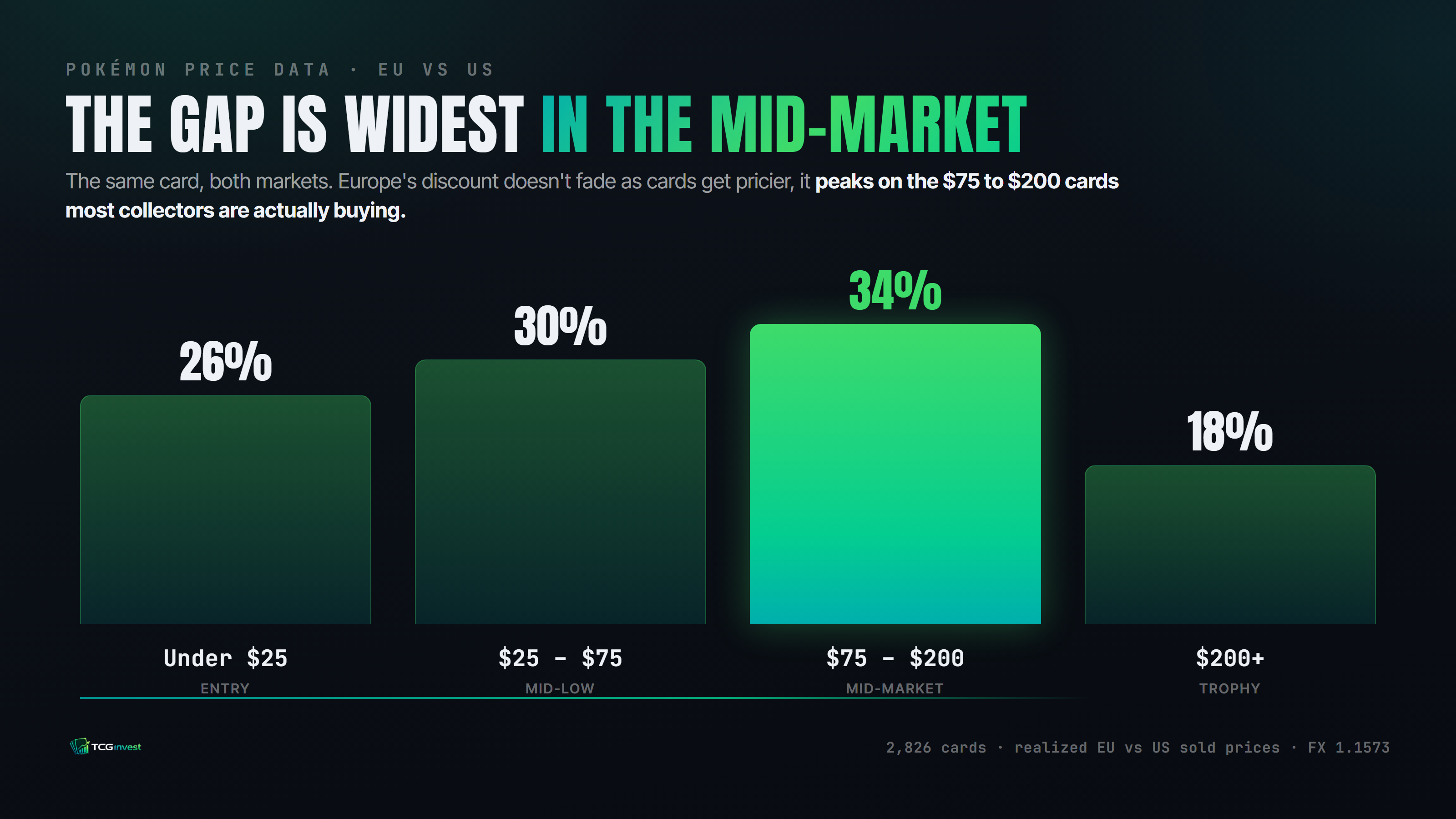
The very top of the market ($200+) tightens up. Trophy cards are globally priced and arbitraged hard, so the gap compresses to about 18%. But everything below it, the bulk of what changes hands, sits in the 26 to 34% range. The cheaper the card, the less a US buyer should assume they're getting a fair deal by buying at home.
And it's an era story too
Break it down by print generation and one era stands out:
| Era | Median European discount |
|---|---|
| Vintage (2003 and earlier) | 27% |
| EX / DP / HGSS (2004 to 2011) | 38% |
| Modern (2012 onward) | 15% |
The mid-2000s (EX-era, Diamond & Pearl, HGSS) is where Europe is cheapest relative to the US, a 38% median gap. These are the cards a generation of European kids opened, held, and are now selling back into a deep local market, while US demand for the same cards carries a scarcity premium. Modern cards (2012 onward) show the smallest gap at 15%, because they were printed and distributed globally from day one, so the two markets never drifted as far apart.
What it looks like on real cards
A few examples. These aren't thin cards cherry-picked for effect. Each one is among the most heavily traded cards we track, with at least 60 raw sales behind its US median in the trailing 180 days (PriceCharting's sale counter caps at 60, so the real figure is higher). The European number is the 30-day realized average, not a single listing. So these aren't figures that swing when one card sells:
| Card | Set | Europe | United States | Gap |
|---|---|---|---|---|
| Gengar ex | Temporal Forces | €25.72 (~$29.77) | $55.78 | 47% less |
| Gyarados-GX | Crimson Invasion | €10.90 (~$12.62) | $22.96 | 45% less |
| Snorlax (reverse holo) | Fates Collide | €8.84 (~$10.23) | $18.16 | 44% less |
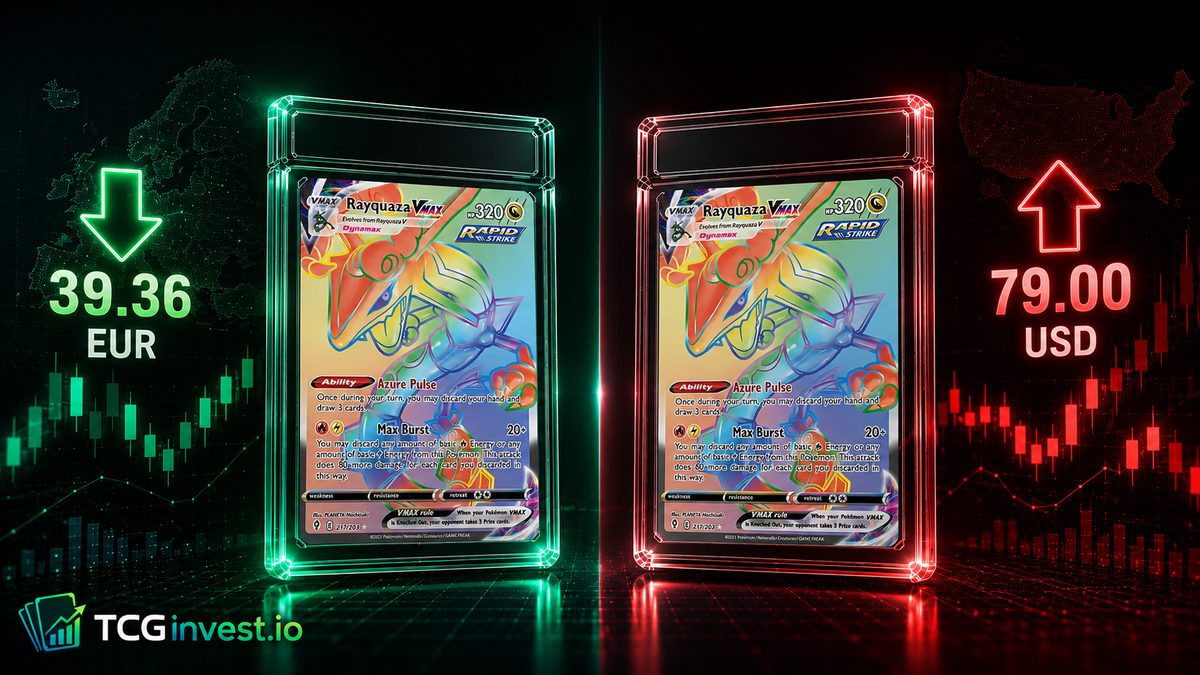
| Rayquaza VMAX | Evolving Skies | €39.36 (~$45.55) | $79.00 | 42% less |
| Pikachu | Cosmic Eclipse | €77.14 (~$89.27) | $148.34 | 40% less |
| Lugia-GX | Lost Thunder | €16.24 (~$18.79) | $30.24 | 38% less |
None of these are obscure. They're the kind of card a collector adds without thinking twice, and the kind where a US buyer paying the home price is quietly leaving 30 to 50% on the table.




Tap any card to see its full European and US price history.
Why the two markets drifted apart
We measure consequences, not motives, but the structural reasons here are not mysterious:
- Cardmarket is a deeper, more competitive marketplace. It's a pan-European exchange with thousands of sellers listing the same card side by side, no auction theatre, and low friction. More sellers competing on the same card means thinner margins and prices that settle lower.
- The US market carries a premium. Most American volume runs through eBay and TCGplayer, where seller fees are higher and where slab culture, hype cycles, and a larger speculative buyer base all push realized prices up.
- Supply sits where the cards were opened. Europe absorbed enormous quantities of EX-era and DP/HGSS product. That supply is now being sold back into a local market, while US demand prices the same cards as scarcer than they are over there.
None of this is a temporary glitch. It's the standing shape of two large markets that price the same asset differently, which is exactly the kind of structural gap that doesn't close on its own.
The one catch: who actually keeps the discount
Here's the honest part, because it decides whether any of this matters for you.
If you're in Europe, this is simply the price. You buy on Cardmarket, you pay the European number, the 28% is yours. No asterisk.
If you're in the US, the gap is real but you don't keep all of it. International shipping and the occasional customs charge eat into a single-card import, sometimes enough to erase the edge on a cheap card, rarely enough to erase it on a $75+ one. The discount is largest exactly where it survives the shipping math best, the mid-market cards above. It's not "import everything." It's "the home price is not the fair price, and on a meaningful card it's worth checking the other side of the Atlantic before you buy."
What it means
The single most useful habit this data argues for is a small one: stop treating one market's price as "the" price. The same Pokémon card has two prices that disagree by a median of 28%, and which one you see depends entirely on which marketplace you happened to open first.
That gap is also the reason we price every card on TCGinvest in its real European terms instead of a converted US figure. For most of the catalog, the US number is the expensive number, and a European collector valuing a collection in dollars is overstating it by roughly a third. Knowing both sides is the whole point.
The cards don't care which ocean you're on. The prices do.
Find the best cards to invest in → the Leaderboard
The 100 best card investments, surfaced from the 17,000+ Pokémon cards we track. We score and rank the catalog so the ones actually worth buying rise to the top. Wherever you buy, this is where you find the ones quietly mispriced.
Prices are realized sale figures: Cardmarket 30-day sold averages and PriceCharting 180-day sold medians, converted at €1 = $1.1573 as of 9 June 2026, across 2,826 cards with at least 8 recorded US sales each. Market prices move and individual cards vary. Not financial advice.