
Sealed product finished first when we measured it against raw singles and PSA 10 slabs, and first again when we measured all three against the stock market: a median 238% over five years, against the S&P 500's 80.9%. So the next question is the one that actually costs money. When do you buy it?
Roughly one to four months after the set comes out, with day 60 the cheapest fixed date we tested. Not on pre-order, which was the worst option.
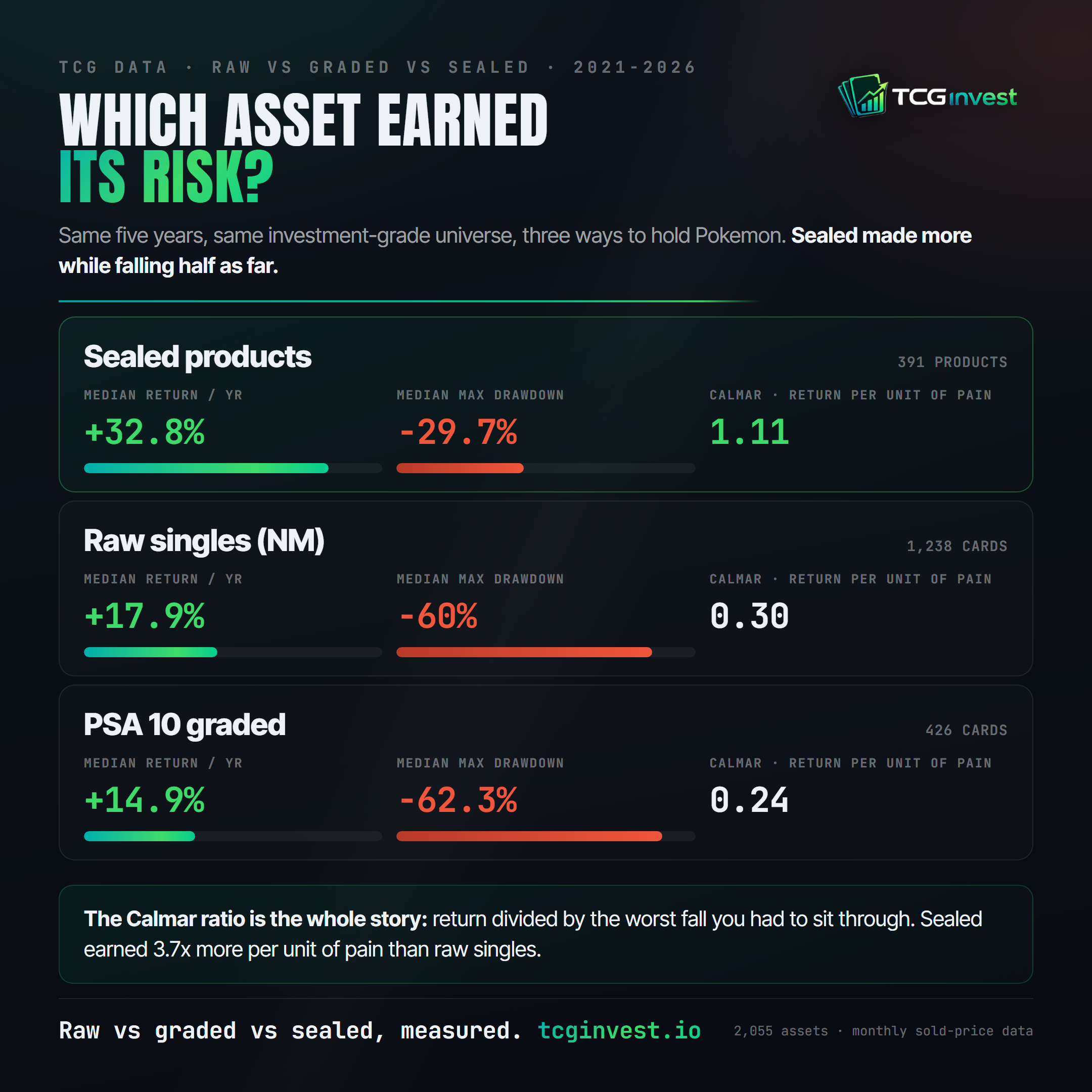 Same five years, same investment-grade universe, three ways to hold Pokémon. From our raw vs graded vs sealed study, where the full method and the era breakdown live.
What we tested
We priced booster boxes and elite trainer boxes every single day, starting at least three weeks before each one was released. That is 43 of the 52 English boxes released between March 2024 and March 2026; the other nine are ones we did not start pricing early enough.
Then we tested fixed calendar dates rather than the day that happened to be cheapest, because the cheapest day is only visible afterwards. Day 30 every time, day 60 every time, and so on. Each date is measured against what the same box cost on release day. Of the 43 boxes, 35 carry a usable price at every one of those dates, and those 35 are the table below. No product was included or excluded on the basis of how its price later behaved.
| Bought | Price paid vs release day | Where it stands today |
|---|---|---|
| Pre-order, 14 days before | 1.05x | +29% |
| Release day | 1.00x | +67% |
| Day 30 | 0.93x | +85% |
| Day 60 | 0.87x | +88% |
| Day 75 | 0.89x | +91% |
| Day 90 | 0.91x | +85% |
| Day 120 | 0.92x | +75% |
| Day 180 | 0.99x | +71% |
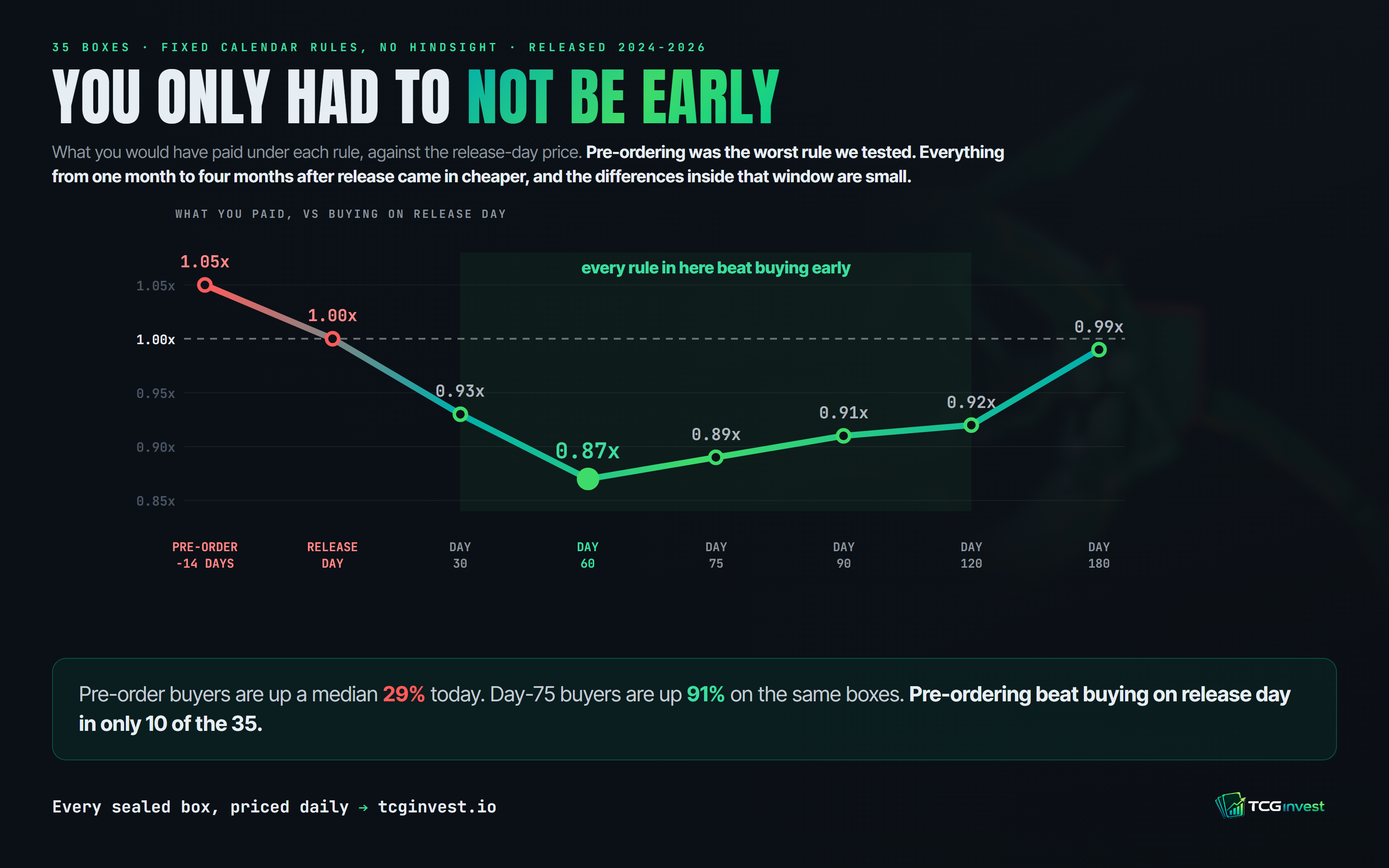 Eight fixed buying dates, each measured against what the same box cost on release day. 35 boxes released 2024 to 2026, priced daily.
Every date between day 30 and day 120 beat both pre-ordering and buying on release day, and the differences inside that window are small. You did not need to pick the bottom. You needed to not be early.
Pre-ordering was the worst rule on both measures: you paid the most, and those boxes are up a median 29% today against 91% for the day-75 buyer on the same boxes. Pre-ordering beat buying on release day in only 10 of the 35.
Why the early price is the high one
Here is one box in detail. The Phantasmal Flames Pokémon Center Elite Trainer Box, a limited-run edition sold in capped quantities, was listed at $588 three weeks before the set launched. On 13 November, the day before release, $537. On release day itself, $389. The next day $302. A week later $186.
The gap tracked how hard the box was to get. Limited editions in our sample were listed 90% above their post-release price, standard elite trainer boxes 19%, and ordinary booster boxes 7%. We did not measure who was selling at each point, so we are describing the pattern rather than proving the mechanism, but the ordering is consistent across all three groups.
Product type also changes how long the fall lasts. Booster boxes reached their low a median 30 days after release. Elite trainer boxes took around three months. So the one to four month window is an aggregate of the two, and for booster boxes specifically it opens and closes earlier.
Then it stops getting cheaper
That is the part people do not expect. Waiting pays for a couple of months, and then it stops paying.
We checked this on a second, longer dataset: 25 boxes followed monthly from their own release month, some for five years, indexed to what each settled at early on. We looked at every month from two to twenty-four, and the median never came in below that settled price.
| Months since release | Typical price | Share above the settled price |
|---|---|---|
| 6 | +16% | 80% |
| 12 | +19% | 76% |
| 18 | +97% | 88% |
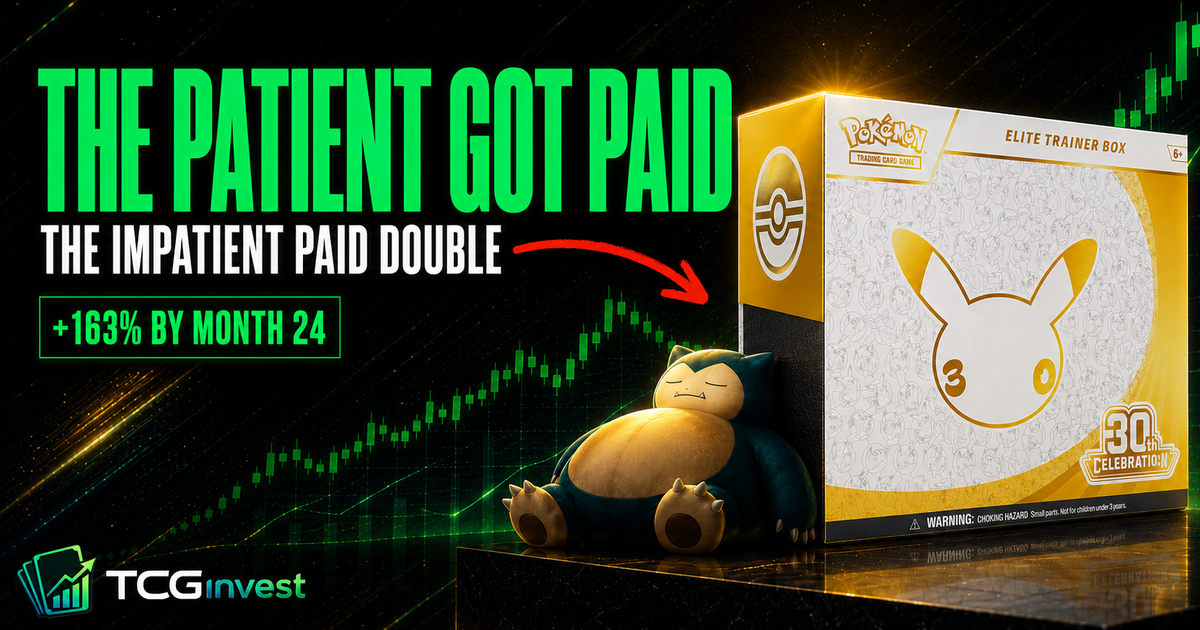
| 24 | +163% | 95% |
Not month twelve, when the set has finished printing. Not month eighteen. By two years, 18 of the 19 boxes old enough to check were above their settled price.
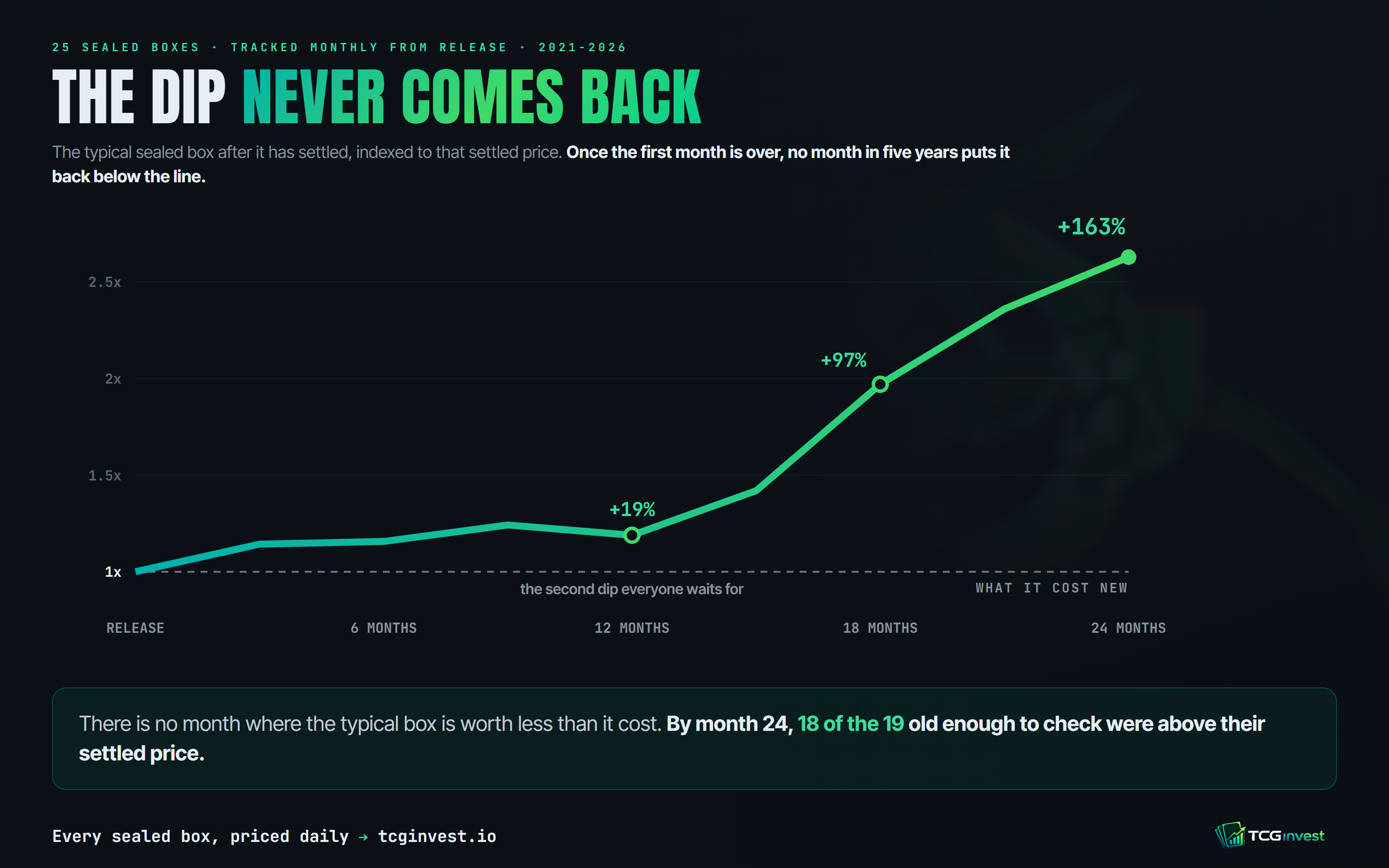 25 boxes priced monthly from their own release month, 2021 to 2025. The count falls to 19 by month 24 because six are not yet two years old.
This is a statement about the median, not a promise about any single box. Individual boxes did revisit their lows. What we did not find was a second market-wide dip in the long-run sample.
The honest caveat
The size of that climb is not a law. Split the 25 boxes by the year they came out and the later ones beat the earlier ones at every age: a 2022 box at twelve months old was 1.04x, a 2023 box 1.15x, a 2024 box 2.28x. Same age, very different outcome.
So the +163% at month 24 belongs partly to the market those boxes lived through, which was a recovery. Our window covers one bubble and one recovery, and the daily half of it covers only two years, all of them without a sustained downturn. Treat the shape as reliable and the size as of its time. Three boxes out of 43 rewarded buying early, all from sets that kept climbing after release instead of settling, and we could not have told you in advance which three.
What it comes down to
There is one cheap stretch in the life of a sealed box, and it runs from roughly one month to four months after the set is released, with day 60 the cheapest fixed date we tested. Before it you are paying a premium that lasts only until shops have stock. After it, the median in our long-run sample stayed above the early settled price at every checkpoint we looked at.
Which leaves the question the earlier two studies pointed at all along: once a box is a few months old, the timing question is answered and what remains is which box.
So which boxes? Every sealed product we track has its own page carrying the same release-day-to-today history this article is built on, ranked on the sealed leaderboard. A free account keeps the ones you are following in one place and puts you on the list for the next study we publish. If you would rather have the day to day than the research, every card the engine flags below its own recent level lands on our public signals ledger and in a free Telegram channel.
Method in brief: daily TCGplayer prices for booster boxes and elite trainer boxes released between March 2024 and March 2026, each tracked from at least 21 days before its release date. That is 43 of the 52 eligible products; case lots, code cards, retailer bundles and multi-packs are excluded. The fixed-rule table uses the 35 boxes carrying a price at every checkpoint, taking the nearest available daily price within seven days of each target date. "Where it stands today" compares that price to the median of the last fortnight of our data, which ends 15 June 2026. Each box's observed low is the minimum of a seven-day rolling median across its first 180 days, so one bad print cannot define it; that low fell a median 76 days after release, with half the boxes between day 30 and day 124. The long-run table uses monthly medians for 25 boxes priced continuously from their own release month, 2021 to 2025, indexed to the lower of each box's first two tracked months. Series copied from a sibling product rather than priced independently are excluded throughout, single-month glitches are screened in both directions, and every figure was checked against a second price source. All prices are market prices before fees, shipping and spread. Full detail on our methodology page.