
On modern cards, it does not matter. Collectr, Pokedata and TCGplayer's market price agreed with each other within 1% on almost every card we tested and sat a median 7% above what buyers actually paid.
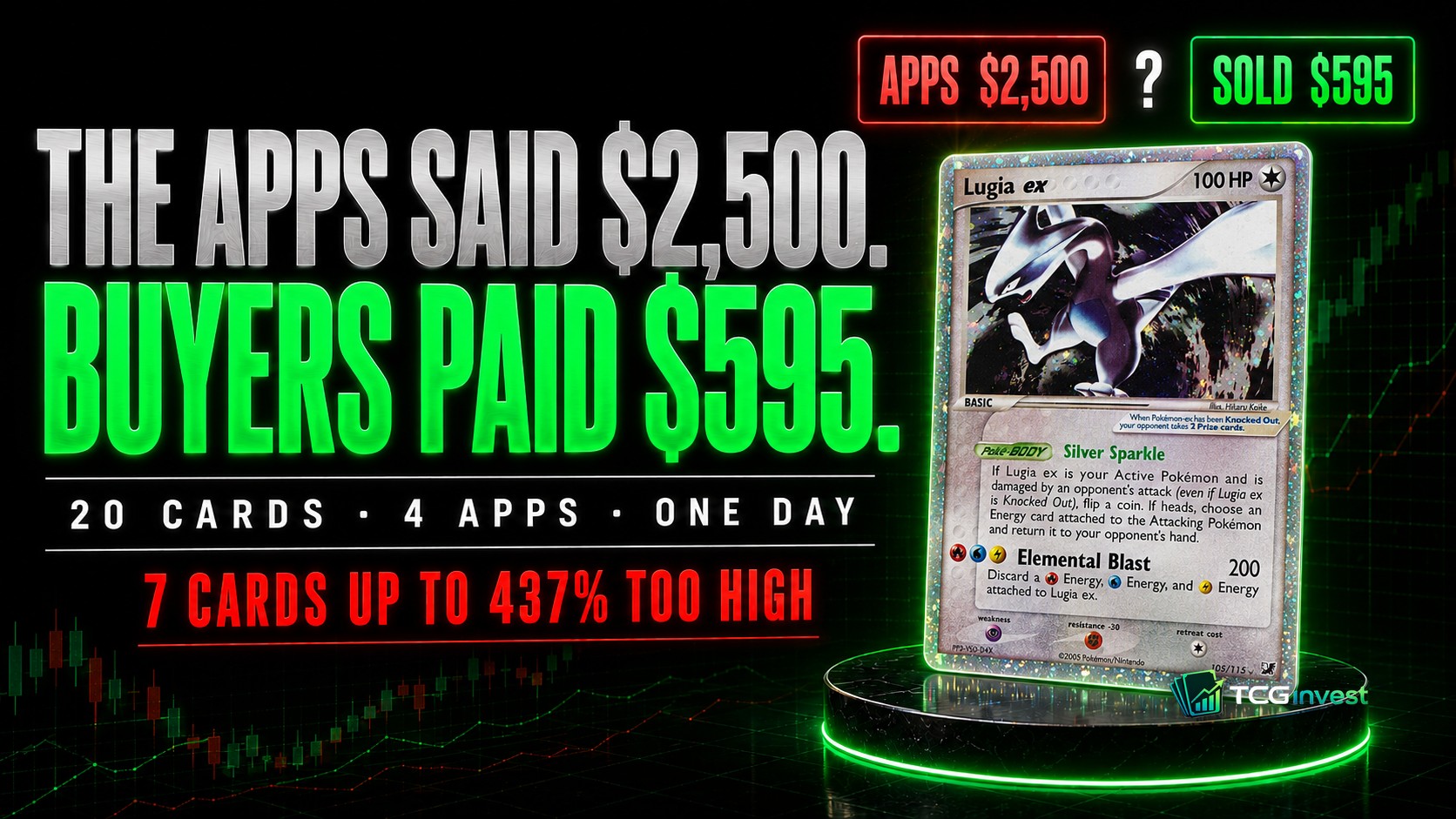
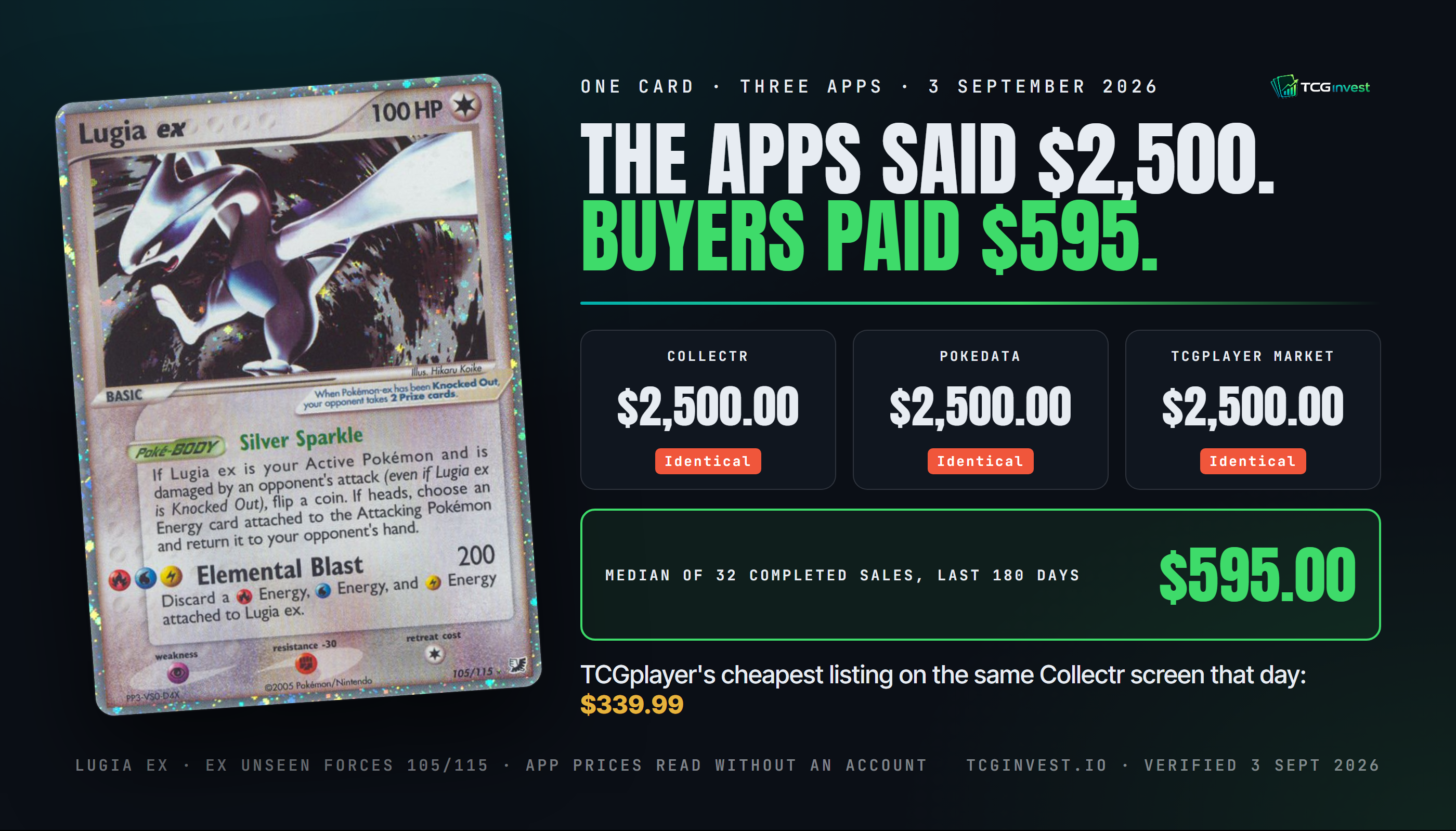
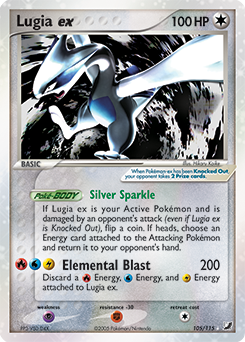
On older cards, none of the apps is safe. Seven of our 20 cards showed 46% to 437% more than the median completed sale, in every app, on the same day. Lugia ex from Unseen Forces: the apps said $2,500. Buyers paid $595.
Closest to a real sale: PriceCharting, within 10% on 16 of 20 cards. Least reliable number in any app: Pokedata's European price, which matches a feed last updated in November 2025.
- Collectr versus median completed sale, 20 cards: median 8% above, within 10% on 11 of 20, worst 437% above.
- Pokedata (US dollars): median 6% above, within 10% on 11 of 20, worst 341% above.
- TCGplayer market price: median 8% above, within 10% on 11 of 20, worst 340% above.
- PriceCharting ungraded price: median 5% below, within 10% on 16 of 20, worst 62% above.
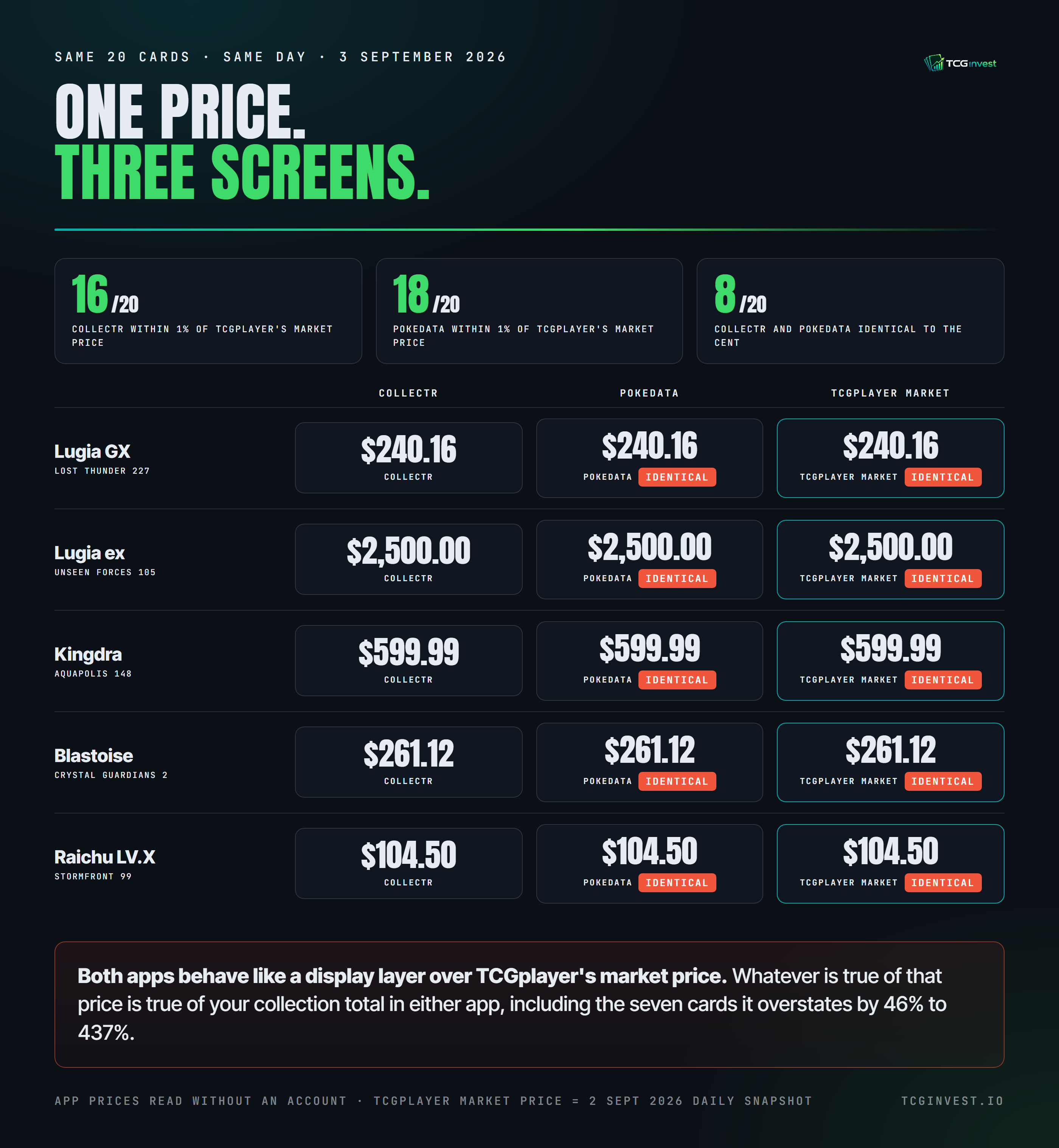
- Collectr within 1% of TCGplayer's market price: 16 of 20 cards. Pokedata: 18 of 20. Collectr and Pokedata identical to the cent: 8 of 20.
- Pokedata's Cardmarket price equal to a public feed stamped November 2025 or January 2026: 18 of 20 cards.
Source: TCGinvest (tcginvest.io). App prices read on 3 September 2026 without an account. Completed sales are the 60 most recent ungraded eBay sales recorded by PriceCharting, median taken over the last 180 days.
The 20-card test
Most "best Pokémon card app" articles compare features. We compared numbers. We took 20 English cards, opened each one in Collectr and Pokedata, read TCGplayer's market price and PriceCharting's ungraded price for the same card, all on the same day, and put every figure next to the one thing none of them can argue with: the median price buyers actually paid for that card over the previous six months.
The 20 were chosen to cover the collection a real person owns. Eight modern chase cards that sell every day. Five mid-era cards from 2014 to 2020. Seven vintage cards from 2002 to 2009, three of them with fewer than 30 sales in six months. Two of them, Umbreon VMAX and Lugia ex, were also in our July Collectr check, so you can see how the apps moved.
| Card | Collectr | Pokedata | TCGplayer | PriceCharting | Sold, median | Sales | Collectr vs sold |
|---|---|---|---|---|---|---|---|
| Umbreon VMAX Evolving Skies 215 | $2,235.94 | $2,380.00 | $2,380.34 | $2,095.75 | $2,262.50 | 60 | -1% |
| Gengar VMAX Fusion Strike 271 | $1,025.91 | $1,032.00 | $1,034.78 | $803.49 | $927.50 | 60 | +11% |
| Giratina V Lost Origin 186 | $826.57 | $827.00 | $832.41 | $798.36 | $799.89 | 60 | +3% |
| Lugia V Silver Tempest 186 | $524.94 | $526.00 | $525.93 | $451.37 | $500.00 | 60 | +5% |
| Charizard ex Paldean Fates 234 | $280.79 | $280.79 | $280.84 | $255.40 | $282.12 | 60 | 0% |
| Pikachu ex Surging Sparks 238 | $288.79 | $289.90 | $289.90 | $261.52 | $288.64 | 60 | 0% |
| Reshiram ex White Flare 173 | $488.72 | $490.98 | $490.98 | $473.34 | $490.00 | 60 | 0% |
| Greninja ex Twilight Masquerade 214 | $370.23 | $370.23 | $369.35 | $310.76 | $350.00 | 60 | +6% |
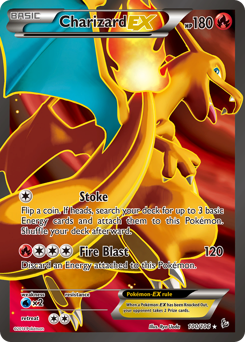
| Charizard EX Flashfire 100 | $266.79 | $266.79 | $269.26 | $168.95 | $182.76 | 47 | +46% |
| M Gengar EX Phantom Forces 121 | $563.68 | $564.00 | $563.68 | $136.25 | $128.00 | 38 | +340% |
| Pikachu Cosmic Eclipse 241 | $225.09 | $225.80 | $226.32 | $202.55 | $209.48 | 60 | +8% |
| Pikachu VMAX Vivid Voltage 188 | $186.05 | $183.40 | $183.40 | $136.20 | $171.44 | 60 | +8% |
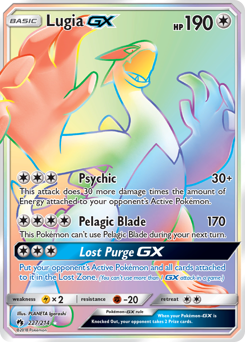
| Lugia GX Lost Thunder 227 | $240.16 | $240.16 | $240.16 | $209.81 | $224.50 | 33 | +7% |
| Lugia ex Unseen Forces 105 | $2,500.00 | $2,500.00 | $2,500.00 | $961.17 | $595.00 | 32 | +320% |
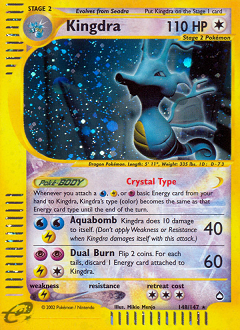
| Kingdra Aquapolis 148 | $599.99 | $599.99 | $599.99 | $347.50 | $371.00 | 31 | +62% |
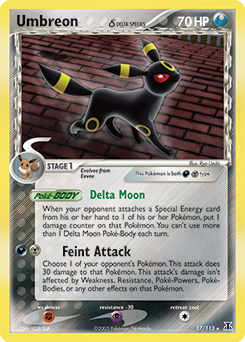
| Umbreon Delta Species 17 | $995.00 | $504.00 | $504.41 | $199.25 | $185.19 | 36 | +437% |
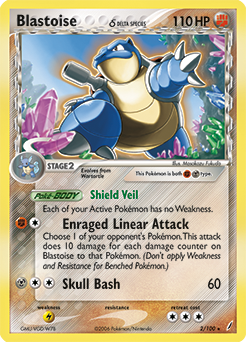
| Blastoise Crystal Guardians 2 | $261.12 | $261.12 | $261.12 | $168.66 | $176.25 | 46 | +48% |
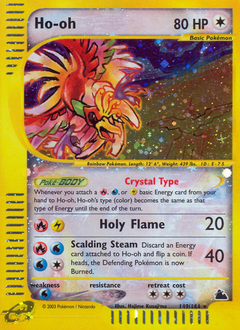
| Ho-oh Skyridge 149 | $2,000.00 | $400.00 | $800.00 | $540.88 | $540.88 | 21 | +270% |
| Garchomp LV.X Majestic Dawn 97 | $187.00 | $102.66 | $187.00 | $150.47 | $139.95 | 13 | +34% |
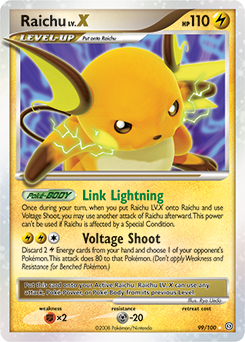
| Raichu LV.X Stormfront 99 | $104.50 | $104.50 | $104.50 | $102.50 | $98.92 | 24 | +6% |
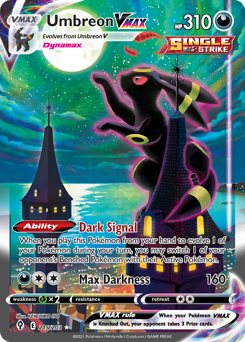



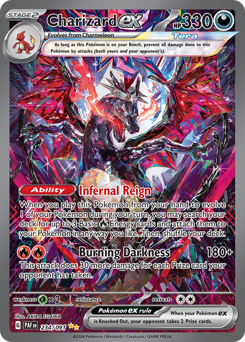
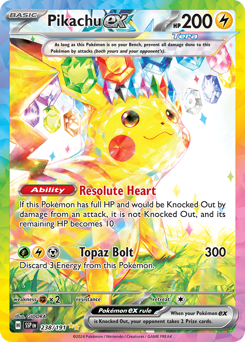
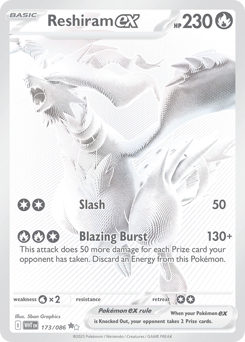





Pokedata shows whole dollars on cards above $500, which is why $2,380 sits next to $2,380.34. "Sold, median" is the median of completed ungraded sales in the last 180 days; "Sales" is how many, capped at the 60 most recent that PriceCharting lists. Tap a card name to open its page.
The scoreboard
| Source | Median distance from a real sale | Typical miss | Within 10% | Above the sale | Worst miss | Closest source |
|---|---|---|---|---|---|---|
| Collectr | +8% | 8% | 11 of 20 | 17 of 20 | +437% | 5 of 20 |
| Pokedata | +6% | 7% | 11 of 20 | 17 of 20 | +341% | 2 of 20 |
| TCGplayer market price | +8% | 8% | 11 of 20 | 19 of 20 | +340% | 1 of 20 |
| PriceCharting | -5% | 7% | 16 of 20 | 5 of 20 | +62% | 12 of 20 |
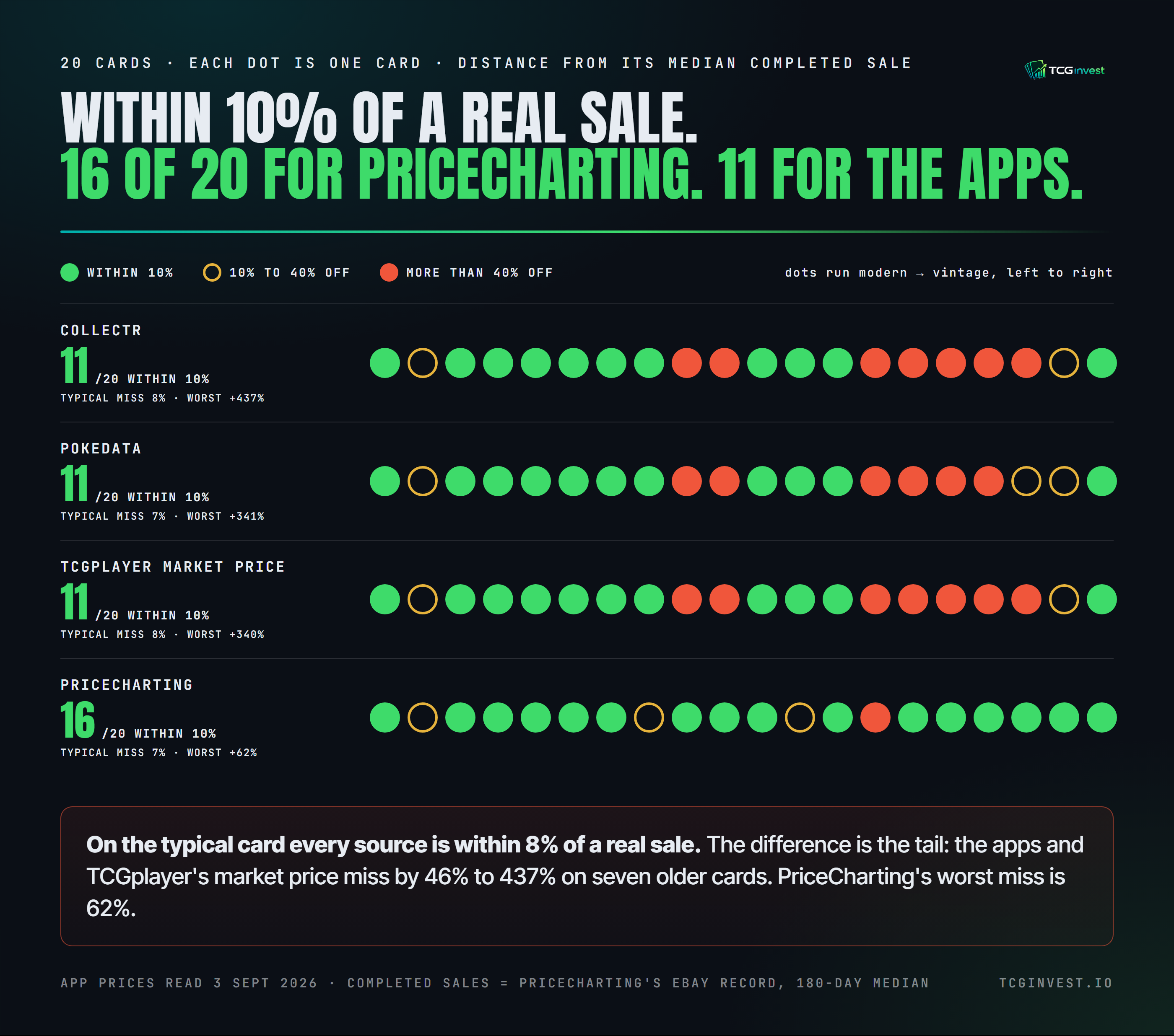
"Typical miss" is the median of the absolute distance. Read the two halves of the table separately. On the median card, all four sources are within 8% of a real sale and there is nothing to choose between them. The difference is entirely in the tail: how badly each source misses when it misses.
Every card page on TCGinvest shows the TCGplayer price, the PriceCharting figure and the Cardmarket trend for Europe side by side, each dated, with the number of completed sales behind the sold figure. Free, no account needed. Search a card on TCGinvest and compare it with what your app shows.
Collectr and Pokedata are showing you the same number
The first thing the table settles is that "Collectr vs Pokedata" is mostly a comparison of two windows onto one price. Collectr's displayed price was within 1% of TCGplayer's market price on 16 of 20 cards. Pokedata's was within 1% on 18 of 20. On eight cards the two apps showed the identical figure to the cent, and on five of those TCGplayer's market price was the same to the cent as well: Lugia GX at $240.16, Lugia ex at $2,500.00, Kingdra at $599.99, Blastoise at $261.12 and Raichu LV.X at $104.50.
Neither app publishes a formula. Collectr's own site says it shows eBay and TCGplayer listings and sold listings. Pokedata labels its US dollar column "TCGPlayer" outright. What we can say from the data is that both apps behave like a display layer over TCGplayer's market price, and that whatever is true of that price is true of your collection total in either app.
The two cards where Collectr broke from Pokedata are instructive. On , Collectr opened on $995 and Pokedata on $504. The $995 is TCGplayer's market price for the reverse holo printing, which Collectr shows first; the $504 is the regular holo. On , Collectr's headline was a "Holofoil" line that has read a flat $2,000 since September 2025, while its own chart shows the printing that actually trades at about $800. Both are what the app shows when you open the card, so both are in the table, and both are 270% to 437% above what the card sells for.
Where the apps go wrong: seven cards, 46% to 437% too high
Sort the table by age and the pattern is unmissable. The eight modern cards at the top sit between 1% below and 11% above a real sale in Collectr, median 2% above. Every card that missed by more than 40% was printed between 2002 and 2014.
| Card | Apps showed | Buyers paid (median) | Gap |
|---|---|---|---|
| Umbreon Delta Species 17 | $995.00 (Collectr) | $185.19 | +437% |
| M Gengar EX Phantom Forces 121 | $563.68 | $128.00 | +340% |
| Lugia ex Unseen Forces 105 | $2,500.00 | $595.00 | +320% |
| Ho-oh Skyridge 149 | $2,000.00 (Collectr) | $540.88 | +270% |
| Kingdra Aquapolis 148 | $599.99 | $371.00 | +62% |
| Blastoise Crystal Guardians 2 | $261.12 | $176.25 | +48% |
| Charizard EX Flashfire 100 | $266.79 (Collectr) | $182.76 | +46% |
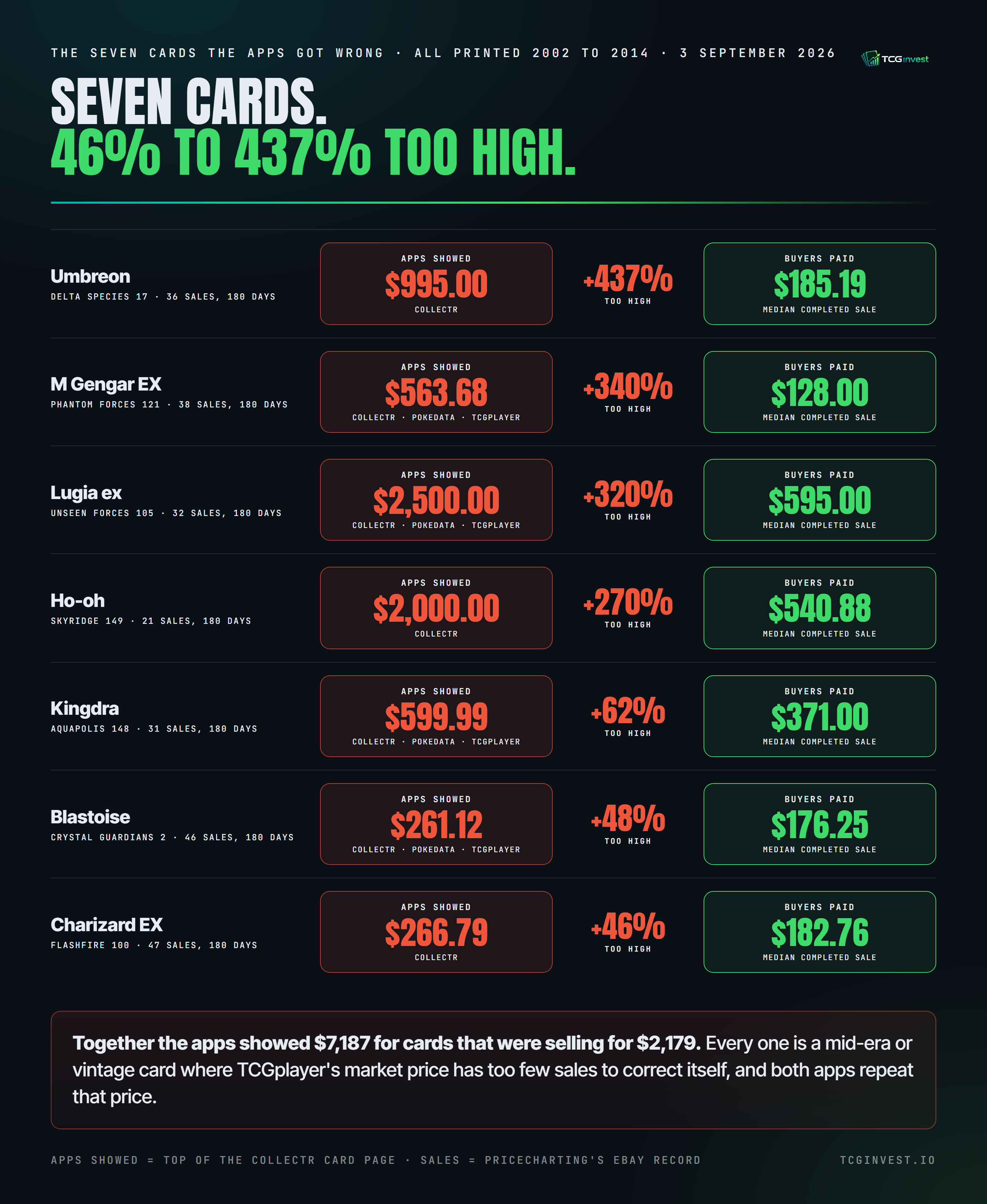
The cause is the same on every row. TCGplayer's market price is a modelled estimate built from recent activity on TCGplayer itself. On a card that sells sixty times a month it is excellent. On a card that sells a handful of times, one high sale or one optimistic listing sets the figure and nothing arrives to correct it. Lugia ex is the cleanest example we have ever seen: on the day the apps showed $2,500, Collectr's own page listed TCGplayer's cheapest copy at $339.99, and 32 buyers in the previous six months had paid a median of $595. The chart on that page shows the price sitting near $650 for a year, then jumping to $2,500 in late August in a single step.
This is not a Collectr bug or a Pokedata bug. It is what happens when a market-price estimate meets a thin market, and it lands on the exact cards that make up a vintage collection. Our July test of 25 cards valued four ways found the same thing from the other direction: cards with fewer than 31 completed sales show a 2.46x median gap between pricing methods, against 1.82x for cards with more.
Is PriceCharting more accurate?
For the question "what would this card sell for", yes, and by a wide margin in the tail. PriceCharting's ungraded price was within 10% of the completed-sales median on 16 of 20 cards and was the closest of the four sources on 12. Its worst miss was Lugia ex at 62% above, against 320% for the apps. Its typical error runs the other way: it sat below the sale on 14 of 20 cards, by a median of 5%.
Two caveats, because the comparison is not entirely fair. The completed-sales record we used as the yardstick is PriceCharting's own list of eBay sales, so PriceCharting is being marked against a test it wrote. And its price follows sales down as readily as up, which is what you want for selling and not what you want for insurance.
Pokedata offers an independent check. Its eBay column is built from a different sales record, and on the outlier cards it pointed the same way: $119 for M Gengar EX against the apps' $564, $363 for Kingdra against $600, $258 for Umbreon Delta Species against Collectr's $995. Across all 20 cards Pokedata's eBay figure sat a median 6% below the completed-sales median, with a typical miss of 12%. We read it without an account, and Pokedata says logged-in users get more recent data, so treat those figures as a floor on its accuracy rather than a verdict.
Is Pokedata accurate?
In US dollars, exactly as accurate as Collectr, because it is the same TCGplayer figure. Within 1% on 18 of 20 cards, a median 6% above a real sale, and 341% above on M Gengar EX. If you are choosing between the two apps on price accuracy alone, there is no difference to find.
Pokedata shows something Collectr does not: three prices per card, from eBay, TCGplayer and Cardmarket, side by side. That is the right idea and the reason we tested it. The eBay column is useful. The Cardmarket column is the problem.
Pokedata's European prices are up to ten months old
Pokedata's Cardmarket figure for Umbreon VMAX reads €1,579. Cardmarket's own trend price for the card on 2 September 2026 was €970.82. The gap is not a methodology difference. It is time.
On 18 of the 20 cards, Pokedata's Cardmarket price matched, to the euro, the Cardmarket block of a public Pokémon card data feed. That feed carries its own timestamp, and for 13 of the 20 cards it reads 18 November 2025, and for five more it reads December 2025 or January 2026. The two cards that did not match the feed were the two Delta Species printings. We checked the feed live on 3 September 2026 and the stamps had not moved.
To measure what that costs, we pulled Cardmarket's current trend price for every card where we could verify the exact Cardmarket product. Ten cards passed that check.
| Card | Pokedata's Cardmarket price | Feed last updated | Cardmarket trend, 2 September 2026 | Pokedata vs today |
|---|---|---|---|---|
| Umbreon VMAX, Evolving Skies 215 | €1,579.00 | 18 Nov 2025 | €970.82 | +63% |
| Gengar VMAX, Fusion Strike 271 | €962.00 | 18 Nov 2025 | €725.45 | +33% |
| Giratina V, Lost Origin 186 | €566.00 | 18 Nov 2025 | €328.59 | +72% |
| Lugia V, Silver Tempest 186 | €388.00 | 18 Nov 2025 | €556.61 | -30% |
| Pikachu, Cosmic Eclipse 241 | €71.73 | 18 Nov 2025 | €136.72 | -48% |
| Pikachu VMAX, Vivid Voltage 188 | €182.07 | 18 Nov 2025 | €151.22 | +20% |
| Lugia GX, Lost Thunder 227 | €190.12 | 18 Nov 2025 | €251.05 | -24% |
| Lugia ex, Unseen Forces 105 | €287.00 | 16 Jan 2026 | €842.03 | -66% |
| Garchomp LV.X, Majestic Dawn 97 | €41.33 | 16 Jan 2026 | €68.51 | -40% |
| Raichu LV.X, Stormfront 99 | €69.57 | 16 Jan 2026 | €39.63 | +76% |
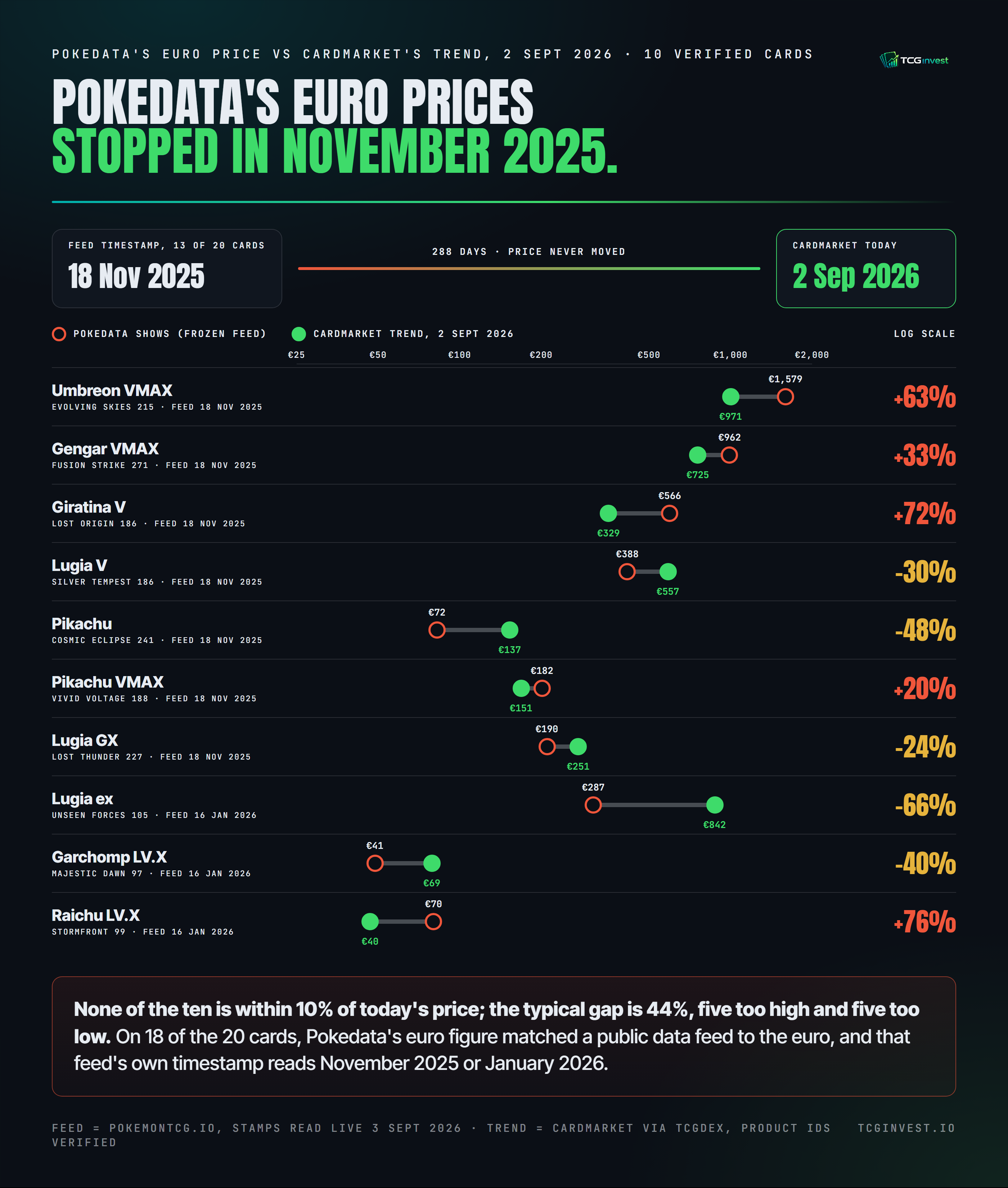
None of the ten was within 10% of today's Cardmarket trend. Two were within 25%. The typical distance was 44%, and the direction was random: five too high, five too low. That is what a frozen price looks like nine months later. A European collector totalling a collection in Pokedata's euro column is looking at last autumn's market, card by card, with no way to tell which cards have moved.
We excluded ten cards from this table, not because they looked better, but because we could not confirm that the live Cardmarket product we pulled was the same printing Pokedata was pricing. The feed match itself held on 18 of 20 regardless.
Which app should you use?
Decide by what you own and what you want the number for.
- A modern collection, in US dollars. Any of them. Collectr, Pokedata and TCGplayer will agree within a few percent and sit a little above what you would get selling. Pick on features.
- Vintage or mid-era cards. Do not trust a single displayed price. Check the completed-sales figure and the sales count before you believe a total. On our seven outlier cards, the apps overstated the collection by $5,008 on cards that were worth $2,179.
- Selling. The completed-sales median, or PriceCharting's ungraded price as the nearest published stand-in.
- Insurance. The higher figures are closer to replacement cost. Just know which one you are looking at.
- A European collection. A Cardmarket price from this week. The median card sells for about 31% less in Europe than in the US, and the European prices inside Pokedata are months old.
TCGinvest shows the TCGplayer market price, the PriceCharting price and the Cardmarket trend on every card, each labelled by source and date, with the completed-sales count beside it. A free portfolio totals your cards for Europe and the US separately, so no single number pretends to be the truth. Start a free portfolio.
How we ran the test
- Date. App prices were read on 3 September 2026. TCGplayer market prices and Cardmarket trend prices are the 2 September 2026 daily snapshots. Completed sales were pulled on 3 September 2026.
- Apps. Collectr and Pokedata were read from their web apps without an account. "Collectr" is the price shown at the top of the card page. "Pokedata" is the TCGPlayer column of the card page, which is also the price it shows in search results.
- Completed sales. The 60 most recent ungraded eBay sales recorded by PriceCharting for each card, median taken over sales in the last 180 days. Every card had at least 13 such sales; 17 had 30 or more.
- Printing. The regular holo printing of each card. Where an app opened on a different printing by default, we recorded what it showed and said so above.
- Cardmarket. Trend price for the exact Cardmarket product matching our catalogue's product ID, taken from a daily mirror stamped 2 September 2026. Cards whose product could not be verified were left out of the European table.
- What we did not test. Graded prices, sealed products, and whichever additional data the apps show to paying or logged-in users.
We will repeat this test each quarter with the same 20 cards and update the tables.
Frequently asked
Which Pokémon card app is most accurate?
On modern cards that sell every day, Collectr, Pokedata and TCGplayer's market price all land within a few percent of what buyers actually paid, and it does not matter which you use. On mid-era and vintage cards, our 20-card test found the apps showing 46% to 437% more than the median completed sale on seven cards, because they display TCGplayer's market price, which breaks when a card has few sales. PriceCharting's ungraded price was closest to a real sale on 12 of the 20 cards.
Is Pokedata accurate?
In US dollars, Pokedata shows the same TCGplayer market figure as Collectr on almost every card, within 1% on 18 of 20 in our test, so it is as accurate as Collectr and no more. Its Cardmarket price is a different story: on 18 of 20 cards it matched, to the euro, a public data feed whose own timestamp reads 18 November 2025 or 16 January 2026. On 10 cards we could verify, none of Pokedata's European prices was within 10% of Cardmarket's trend price on 2 September 2026.
Do Collectr and Pokedata use the same prices?
For US prices, effectively yes. Collectr's displayed price was within 1% of TCGplayer's market price on 16 of 20 cards and Pokedata's on 18 of 20; on eight cards the two apps matched to the cent. Both apps behave like a display layer over TCGplayer's market price.
Why do apps show a vintage card at 3x what it sells for?
TCGplayer's market price is a modelled estimate that needs a steady flow of sales. On a card that sells a few times a month, one high listing or sale can set the figure for weeks. Lugia ex from Unseen Forces showed $2,500 in Collectr, Pokedata and TCGplayer on the same day the median completed sale was $595 and TCGplayer's own cheapest listing was $339.99.
Is PriceCharting more accurate than Collectr?
On our 20 cards, PriceCharting's ungraded price was within 10% of the completed-sales median on 16 of 20 and was the closest source on 12, against 5 for Collectr. Its worst miss was 62% above, against 437% for Collectr. One caveat: the completed-sales record used as the yardstick is PriceCharting's own list of eBay sales, so it has home advantage. Pokedata's independent eBay figure pointed the same way on the outlier cards.
Which price should I use to value a European collection?
A Cardmarket price from today, not a US-dollar figure converted. Our data across 3,370 cards shows the median card sells for about 31% less in Europe than in the US, and the European prices inside Pokedata are months old. We show the Cardmarket trend and the US figures side by side on every card page, each dated.
TCGinvest measures prices daily from Cardmarket (EU), TCGplayer and PriceCharting (US). App figures in this article are what Collectr and Pokedata displayed to a visitor without an account on 3 September 2026; they will have moved since. Nothing here is financial advice, and every number moves.