
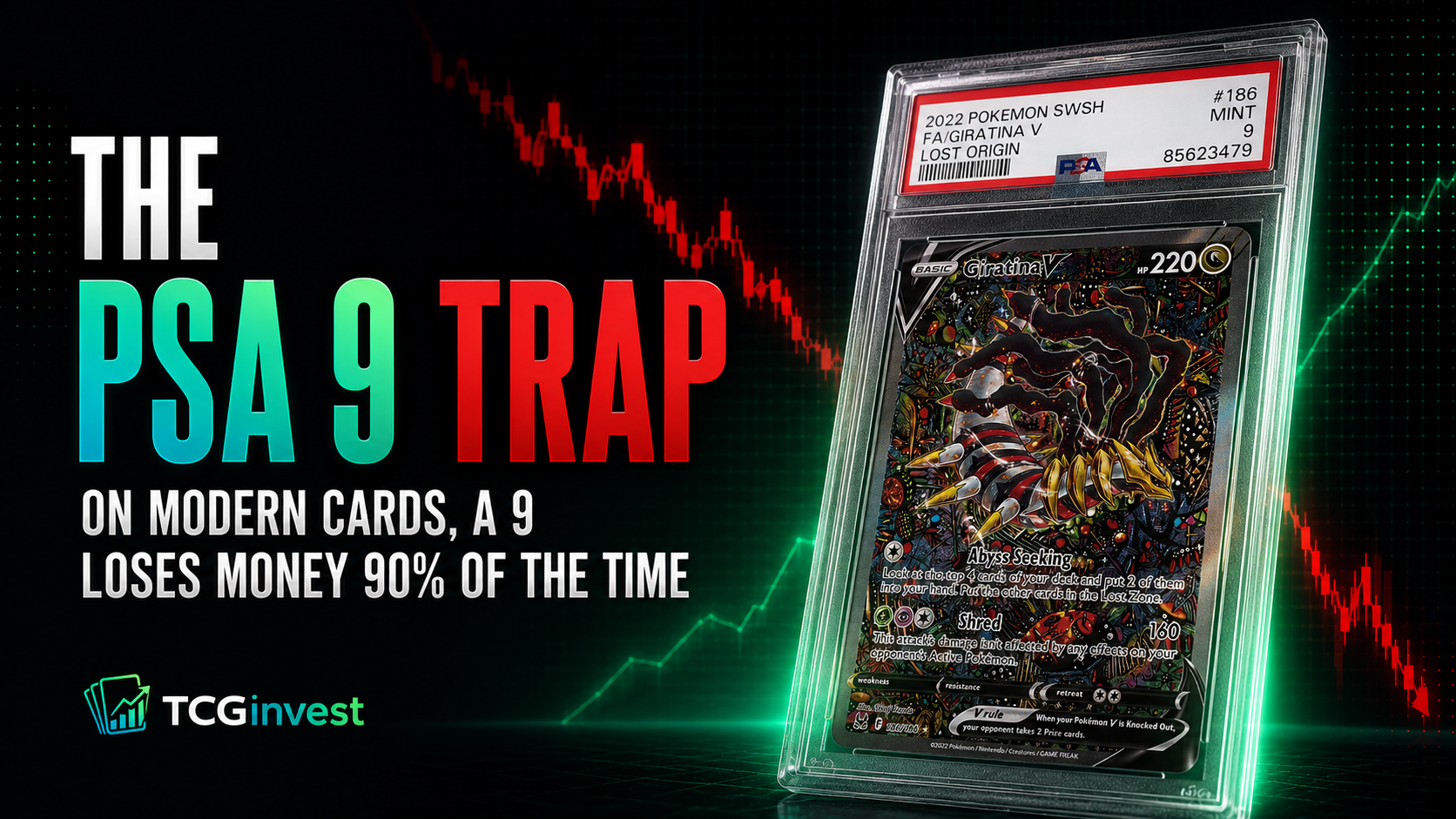
Most people send a card to PSA hoping for a 10 but telling themselves a 9 is a "safe floor." On modern Pokémon cards, it isn't. Using actual PSA sale prices from the last 180 days, not smoothed estimates, a PSA 9 on a card released since 2022 sells for less than the raw card plus a $19 grading fee 90% of the time. On vintage and EX-era cards from 2010 or earlier, that same outcome happens just 4% of the time. Modern grading isn't a premium. It's a coin-flip on a single grade, and the consolation prize is usually a loss.
As of June 2, 2026, the math got worse. PSA paused all four of its Value tiers, so the cheapest way to grade a card is now the Regular tier at roughly $80, about 4x the old floor. At that fee the modern PSA 9 loses money close to 99% of the time, and even the vintage 9 becomes a coin flip (48%). Everything below uses a conservative $19 fee on purpose, because the finding has to survive the friendliest case anyone could claim, not just today's expensive one.
We're TCGinvest. We come from quant trading, and we run the kind of test you'd run on a stock strategy, on Pokémon cards. This one wasn't about returns over time. It's about a single, current price fact that almost no one in the hobby has actually measured: what is a PSA 9 worth, relative to the card you started with?
The answer overturns one of the most repeated pieces of grading advice. And it splits the hobby cleanly in two.
The instinct we tested
Here's the belief, stated the way it usually gets said on forums and in YouTube comments:
"Grade it. Even if it comes back a 9, you'll still make your money back, a graded card is worth more than a raw one."
It's intuitive. A slab feels like an upgrade. The card is the same; now it has a number and a case. Surely that's worth something over the raw card.
We checked. Properly.
What we measured
We took every card-variant in our database with a genuinely liquid graded market, defined before we looked at a single price:
- at least 3 real PSA 10 sales in the last 180 days,
- at least 3 real PSA 9 sales in the last 180 days,
- and a raw price of $5 or more (to keep bulk commons out of it).
That left 1,959 liquid graded markets (across 1,664 distinct cards, holo, reverse and 1st-edition variants of the same card are priced and counted separately). For each one we compared the actual PSA 9 sale median against the raw NM sale median plus a flat $19 grading fee, realized to realized, like for like. Then we split the universe by release era, an attribute fixed long before any price existed: modern (2022+) versus vintage and EX-era (≤2010).
The split is the whole story.
| Era | Cards (n) | PSA 9 sells for less than raw + $19 | Median PSA 9 premium over raw |
|---|---|---|---|
| Vintage / EX (≤2010) | 969 | 4% | ≈$84 |
| Modern (2022+) | 544 | 90% | ≈$10 (below the $19 fee) |
Read it top to bottom. On vintage and EX-era cards, the PSA 9 is a real asset, even the "miss" clears a median $84 over the raw card. On modern cards, the median PSA 9 premium over raw is about $10, less than it cost you to grade it. Nine times out of ten, the slab is worth less than the card you mailed in, plus the fee.
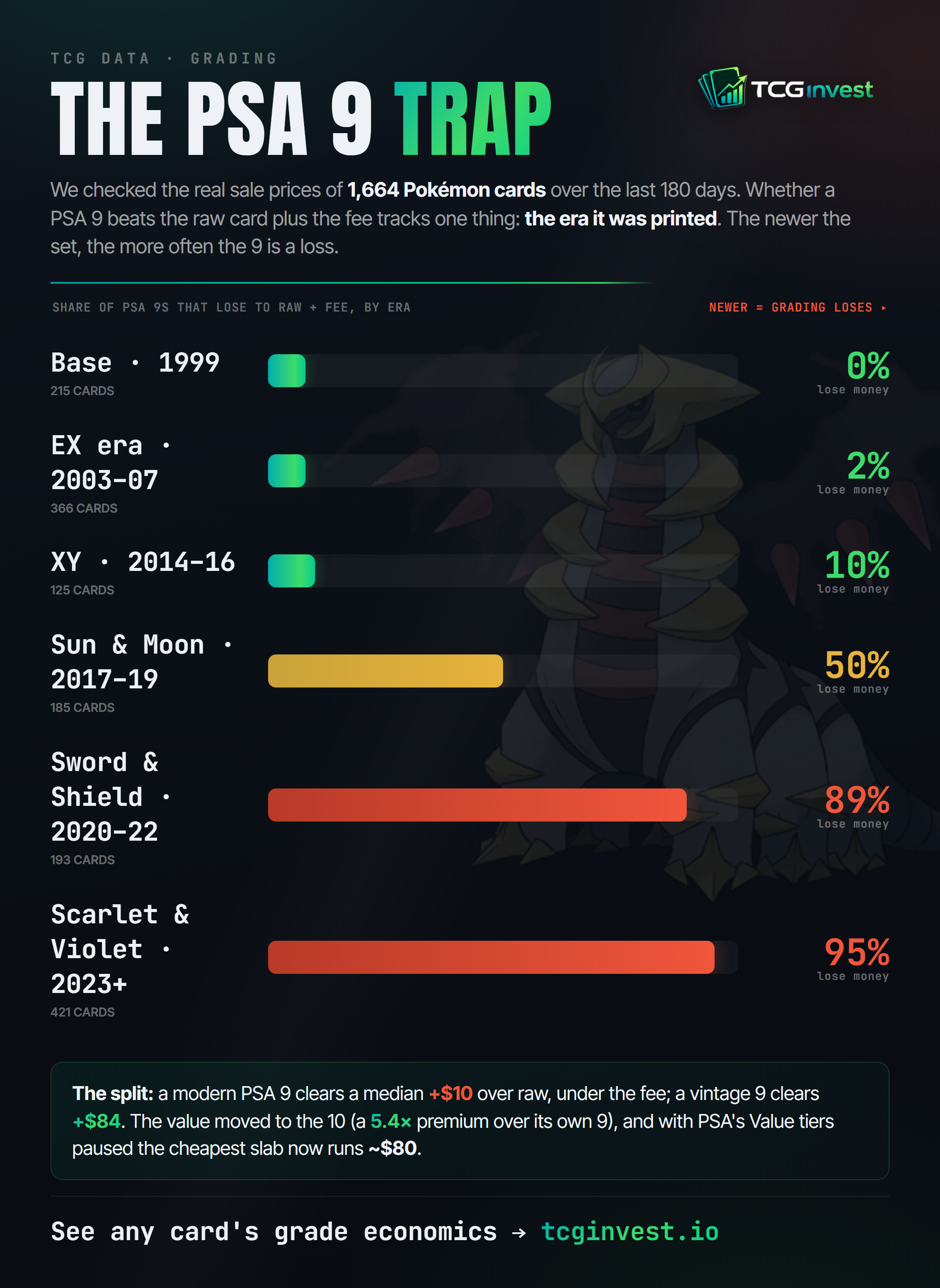
What the chart shows, in plain words:
- The two bars are at opposite ends of the era spectrum, 4% versus 90%.
- The two endpoints are extreme, but the move between them is a ramp, not a switch: the loss rate climbs steadily through the 2010s rather than flipping all at once (see the next section).
- The fee barely matters to the conclusion: even at a $0 fee, 13% of modern PSA 9s still sell below the raw card; at a realistic $15–$25 fee it's 83–95%.
A ramp, not a switch, the era spectrum
We want to be precise about how the 4% becomes 90%, because honesty about the shape matters more than a punchy line.
It is not a clean binary where everything ≤2010 is safe and everything ≥2022 is doomed. The two ends are the extremes, 4% versus 90%, but the loss rate rises monotonically through the intervening years rather than jumping in a single step:
- 2017: ≈37% of liquid PSA 9s sell below raw + fee
- 2019: ≈75%
- 2021: ≈88%
- 2022+: ≈90%
The cards in the excluded middle, released 2011–2021 (n=446 liquid markets), sit at roughly 49% as a group: squarely between the two endpoints, exactly where a steady ramp would put them. We compare the two ends of the spectrum because that's where the practical decision lives, almost everything people are submitting today is modern, almost everything they're holding long-term is vintage, but the honest description is a steep, monotonic age gradient, not a cliff with nothing in between.
That distinction doesn't soften the takeaway for a 2024 card. It just means the right mental model is "the newer the card, the more the value concentrates in the 10," with the 2010s as the transition zone, not "a wall fell in 2022."
The cliff between grades
Now the other number, and this one really is a cliff. Across all 1,959 liquid graded markets, the median PSA 10 sells for 5.4× its own PSA 9, the grade one step below it.
That multiple is the engine behind everything above. When a single grade is worth 5.4×, the value isn't in grading. It's in landing the 10. Miss by one, and on a modern card you've usually paid to convert a raw card into something worth less than the raw card.
This isn't a ranking of grades. It's a monarchy. The 10 takes the value; the 9 keeps the case.
Put a face on it
We're naming cards to illustrate the structure, not to recommend anything. These are the kinds of price relationships the aggregate is built from.
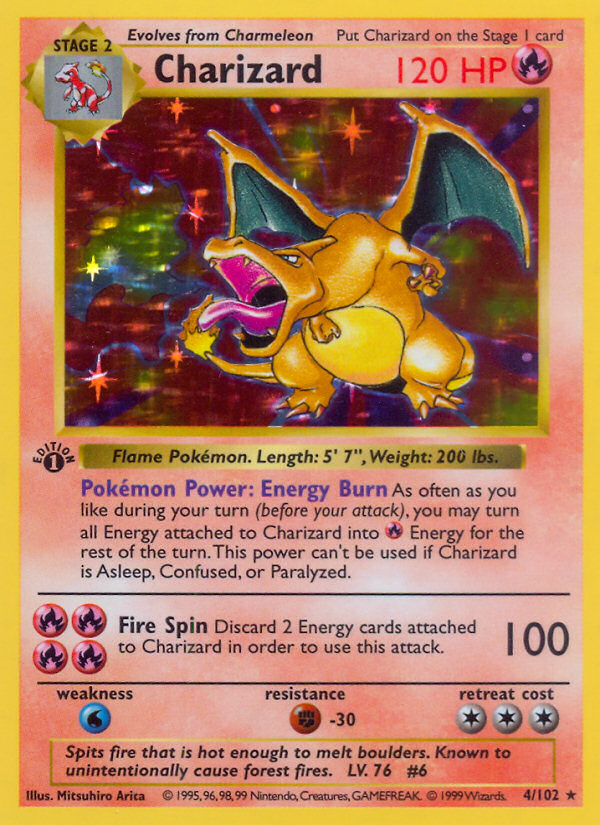
The vintage shape, Base / EX-era chase cards (≤2010)
- A PSA 9 clears a meaningful, durable premium over the raw card.
- The 10 still commands a multiple, but the 9 is a real asset, not a consolation prize (this is the 4% world).

The modern shape, Special Illustration Rares & alt-arts (2022+)
- Huge graded supply, near-pristine print quality, easy 9s.
- The PSA 10 carries almost all the value; the PSA 9 sells at a median premium below the grading fee (this is the 90% world).
Specific cards drift week to week; the structural contrast between the two eras is what's stable.
Why this happens (it isn't a Pokémon quirk)
Modern cards are printed to a standard vintage cards never were, and they're graded en masse while supply is still wide open. When a card grades a 10 easily and often, two things follow: PSA 10s are relatively common, and PSA 9s are very common. Common supply at the 9 level means the 9 prices like a slightly-nicer raw card, because that's effectively what the market treats it as.
Vintage is the mirror image. Decades of handling, no mass submission at print time, and genuine scarcity at every grade. A vintage PSA 9 is rare enough to hold a premium on its own. The grade means something because the population is thin.
This is also why the loss rate ramps with age rather than flipping: as you walk forward from the 2010s into the 2020s, print quality tightens and submission volume swells year over year, so the 9 keeps getting more common and worth relatively less. It's the same dynamic finance has documented for a century: scarcity prices, abundance discounts. Population measures attention. Scarcity measures value. Modern grading floods the lower grades with supply; vintage grading does not. The cards don't care which era they're from. The prices do.
How we made sure this wasn't cherry-picked
You should be skeptical of any "study" in this hobby. This one was built to try to fail.
- No selecting on the outcome. The sample is gated on liquidity, at least 3 real PSA 10 sales, 3 real PSA 9 sales, and a $5+ raw price, never on whether a card went up or down. Era is a pre-existing attribute, fixed at release. The 90%-vs-4% contrast was discovered across pre-defined eras, not engineered.
- The middle isn't hidden. We report the 2011–2021 transition (≈49%) and the year-by-year ramp openly. The endpoints are extreme because the gradient is steep, not because we cut a flattering window.
- Losers and winners both kept in. No market was dropped for being unflattering. Every liquid card-variant in range is in the count.
- Bulk commons floored out. A $5 raw floor removes the rotting-commons artifact. Raise it to $20 and the modern loss rate is still 83%; raise it again and the cliff only sharpens.
- Real sales, not single listings. Every cell requires ≥3 actual sales; the in-sample medians are 9 PSA 10 sales, 17 PSA 9 sales, and 55 raw sales per 180 days. Grade inversions (a 10 priced below its own 9, usually bad data) occur in just 2 of 1,959 rows, and excluding them changes nothing.
- Trustworthy price column only. We use the actual-sale 180-day medians, never the smoothed estimate columns that understate graded prices.
- Two stress tests. Sweep the sales gate from ≥2 to ≥10 and the grade multiple stays 4.5×–5.7×; sweep the fee from $0 to $25 and the modern loss rate runs 13% → 95% while vintage stays in the low single digits up to ≈9% across that whole range.
It was designed to disprove the pattern. It couldn't.
What this does not mean (read this part)
We publish the caveats because the data is solid. That's the difference between research and finance fluff.
- This is a price fact, not a probability of gemming. Our database does not contain per-card PSA grade distributions, so we are not telling you how likely your specific card is to come back a 9 versus a 10. We measured only the price consequence of landing a 9, what the 9 is worth relative to the raw card. That's exactly why the claim is bulletproof: it doesn't depend on any gem-rate assumption.
- It's a tendency, not a law. 90% is not 100%. Some modern PSA 9s do clear the fee. The number characterises the market in aggregate, not your card.
- It's an era ramp, not a hard line. A 2022 card and a 2009 card sit near the two ends; cards from the 2010s sit in between (≈49% around mid-decade). The release year is a strong tendency, not a binary switch.
- It's a snapshot, not a forecast. These are current cross-sectional price levels from the last 180 days of actual sales. It is not a return over time, and the market is under no obligation to keep these relationships.
- It's not anti-grading. The vintage 4% number is the whole point: on the right cards, the 9 is a genuine asset. We're pinpointing where grading stops paying, not condemning grading.
What it means if you actually invest in cards
Observationally, the data says the modern grading proposition is close to binary, the value concentrates almost entirely in the PSA 10, and the PSA 9 prices like a slightly nicer raw card. On vintage and EX-era cards, that concentration relaxes: the 9 holds its own premium. Cards from the 2010s sit on the slope between the two. Two different markets wearing the same plastic case, with a decade-long ramp connecting them.
Notice what we're not doing: naming "cards to grade now," telling you to stop grading moderns, or promising a number on your next submission. We measure consequences, not motives. What the market did over the last 180 days is the entire claim.
How TCGinvest bakes this in
We hold our own model to this. When we score a card, graded value is read from the actual-sale 180-day medians, never the smoothed columns that flatter PSA prices, because using the understated column would quietly overstate how often grading "pays." The era spectrum is structural to how we think about graded markets, not a one-off blog finding. If a number embarrasses our own framing, we'd rather show it than smooth it.
FAQ
Is a PSA 9 always worth less than the raw card? No. On modern (2022+) liquid markets it sells below raw + a $19 fee 90% of the time (n=544); on vintage/EX (≤2010) cards it's only 4% (n=969). Release era is the dividing tendency, with cards from the 2010s falling in between (≈49%).
Why is a PSA 10 worth so much more than a PSA 9? Across the liquid universe the median PSA 10 sells for 5.4× its own PSA 9 (n=1,959). On modern cards, abundant supply at the 9 level means almost all the value concentrates in the 10.
Does the $19 fee assumption drive the result? No. Even at a $0 fee, 13% of modern PSA 9s sell below the raw card; at a realistic $15–$25 fee it's 83–95%. Vintage stays in the low single digits up to ≈9% across that same fee range.
Are these asking prices or real sales? Real sales. Every figure uses actual PSA and raw sale medians over the last 180 days, with a minimum of 3 sales per grade per card.
Is this financial advice? No. It's research and education. Past tendencies do not guarantee future results.
See it on real cards, live
(Rankings are transparent model output, not buy recommendations.)
The takeaway
The biggest surprise wasn't that modern grading is risky. It's where the risk lives. It isn't spread across the submission, it's compressed into a single grade. On a modern card, the PSA 9 and the PSA 10 are not two outcomes on a spectrum. One is a 5.4× asset. The other, nine times out of ten, is worth less than the card you started with. The era spectrum sets the odds; the grade gap sets the stakes. Most graded is not most valuable, and on modern cards, the second-best grade is usually a loss.
Methodology: computed from our database this week, not estimated. Sample = card-variants with a liquid graded market (≥3 actual PSA 10 sales, ≥3 actual PSA 9 sales, and a raw NM price ≥$5) over a trailing 180-day window. Counts are at the (card, variant) level, holo, reverse and 1st-edition printings of the same card are priced and counted separately; the 1,959 liquid markets span 1,664 distinct cards. Prices use actual-sale 180-day medians (PSA 9, PSA 10, raw NM), not smoothed estimate columns. Era from set release date: vintage/EX ≤2010 (n=969 markets / 698 cards), modern ≥2022 (n=544 markets / 541 cards); the excluded 2011–2021 transition (n=446) runs ≈49% and the year-by-year loss rate rises monotonically (≈37% in 2017 → ≈75% in 2019 → ≈88% in 2021). All-era grade multiple computed over n=1,959. Grading fee assumed at a conservative $19 with $0/$15/$25 sensitivity reported (modern 13%→95%; vintage low-single-digits up to ≈9%). PSA paused all four Value tiers on June 2, 2026, making Regular ($79.99) the cheapest current floor, at which the modern loss rate is 98.7% and even vintage rises to ≈48%. We measure the price consequence of landing a PSA 9 versus the raw card, not the probability of receiving a 9 versus a 10 (no grade-distribution data in this dataset). Research and education, not financial advice. Past tendencies do not guarantee future results. TCGinvest is not affiliated with Nintendo, The Pokémon Company, or any TCG publisher.