TCGinvest analysed about 7,500 vintage Pokémon card prices and found that extreme PSA 10 "breakouts" became roughly twenty times more common in 2026, but the data cannot tell whether those moves were manipulation.
Something unusual happened in vintage PSA 10 prices after the Kabuto King went viral. In 2023 and 2024, about 11 vintage cards a month met our breakout test: their PSA 10 price reached at least three times its level four to six months earlier, while the raw card rose less than 50%. In March 2026, 105 cards met it. In August, 246 did. Between March and September, one vintage card in five had at least one breakout.
That does not prove those cards were manipulated. Concentrated buying, PSA set builders, changing demand for vintage slabs, thin sales and price-guide errors can all produce the same pattern. What the data does show is that extreme PSA 10 moves without a matching move in the raw card became dramatically more common.
Documented fraud exists in collectibles, but that is different from proving it in 2026 Pokémon sales. Shill bidding has led to federal prison sentences, and a seller of cards with forged PSA grades was convicted in January 2026. Our separate test found no market-wide pattern of low-population PSA 10s being pumped.
- Vintage cards (released before 2010) with a PSA 10 breakout: about 11 a month in 2023 and 2024, 105 in March 2026, 246 in August 2026.
- 1,509 of 7,609 vintage cards tracked (19.8%) had at least one breakout between March and September 2026.
- The acceleration holds under looser and stricter definitions: 9 to 28 times the 2023 to 2024 rate by August 2026.
- Kabuto 1st Edition PSA 10: $81 in August 2025, when the Kabuto King started buying, $948 at its February 2026 peak.
- Across 1,810 PSA 10s since 2021, cards with 10 or fewer graded spiked less often than cards with over 1,000 (1.5 vs 5.6 sudden jumps per 100 months).
Source: TCGinvest (tcginvest.io), from PriceCharting monthly PSA 10 and ungraded prices and the PSA population report. Analysis run 2 October 2026.
The Kabuto King effect
In August 2025 an anonymous collector started posting the same card again and again: a 1st Edition Kabuto from the 1999 Fossil set, one of the cheapest cards in the set. His stated goal was to own every 1st Edition Kabuto in the world. On 26 November 2025 one of his updates, 24 more Kabutos for a total of 1,718, went viral, and Kotaku and others covered him within days. He now says he owns more than 2,000.
The Kabuto King is an unusually clear public example of how one concentrated buyer can move a thin Pokémon card market. He openly set out to buy as many 1st Edition Kabutos as possible, and the PSA 10 price rose from $81 when he started to a February 2026 peak of $948. Even the unlimited Kabuto, which he does not collect, went from $48 to $708.
The question is not whether his buying affected Kabuto. The interesting question is whether similar patterns appeared elsewhere afterwards.
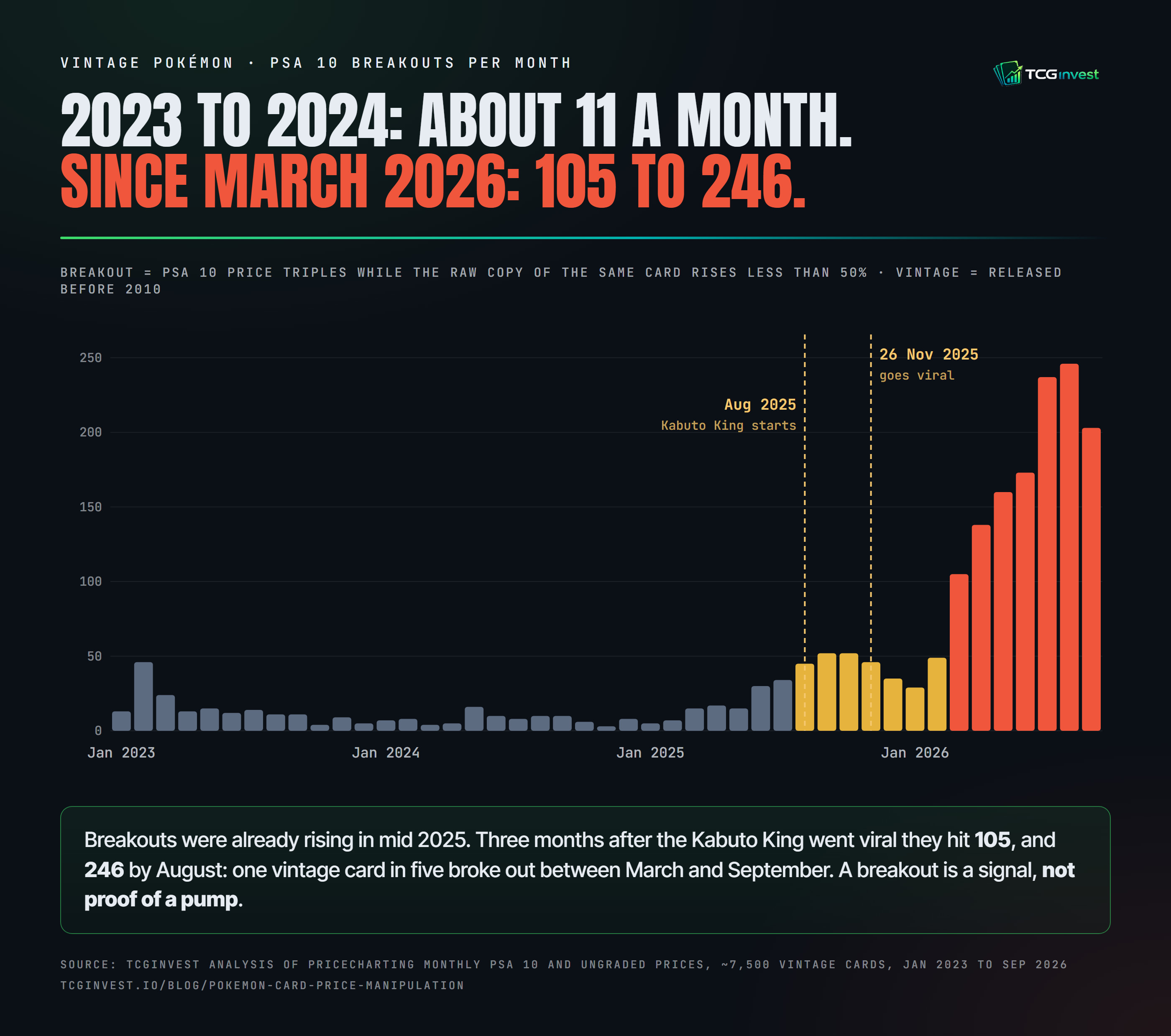
PSA 10 breakouts per month among about 7,500 vintage Pokémon cards: about 11 a month in 2023 and 2024, 105 in March 2026 and 246 in August 2026.
We looked for a pattern like Kabuto's across about 7,500 vintage card prints: the first month in which the PSA 10 price reached at least three times its level four to six months earlier, while the raw copy of the same card rose less than 50%.
We call these "breakouts", not confirmed pumps. The test is built to find unusually large gaps between demand for the top grade and demand for the card itself. Concentrated buying can produce that gap, but so can PSA set building, genuine scarcity of perfect copies, thin sales or bad price data.
- In 2023 and 2024, about 11 cards a month broke out.
- From mid 2025 it rose to 30 to 50 a month. That rise started before the Kabuto King went viral, so he cannot be the whole story.
- In March 2026, three months after he went viral, it jumped to 105.
- Then 138, 160, 173, and 237 and 246 in July and August.
Of the 7,609 vintage cards we could track, 1,509 (about one in five) had at least one breakout between March and September 2026. Almost half of the breakouts are commons and uncommons, often with cheap raw copies and thin PSA 10 markets.
The result does not depend on where we drew the line. Using a 2x, 2.5x, 3x or 4x jump, and a raw limit of 50% or 100%, August 2026 comes out between 9 and 28 times the 2023 to 2024 monthly rate.
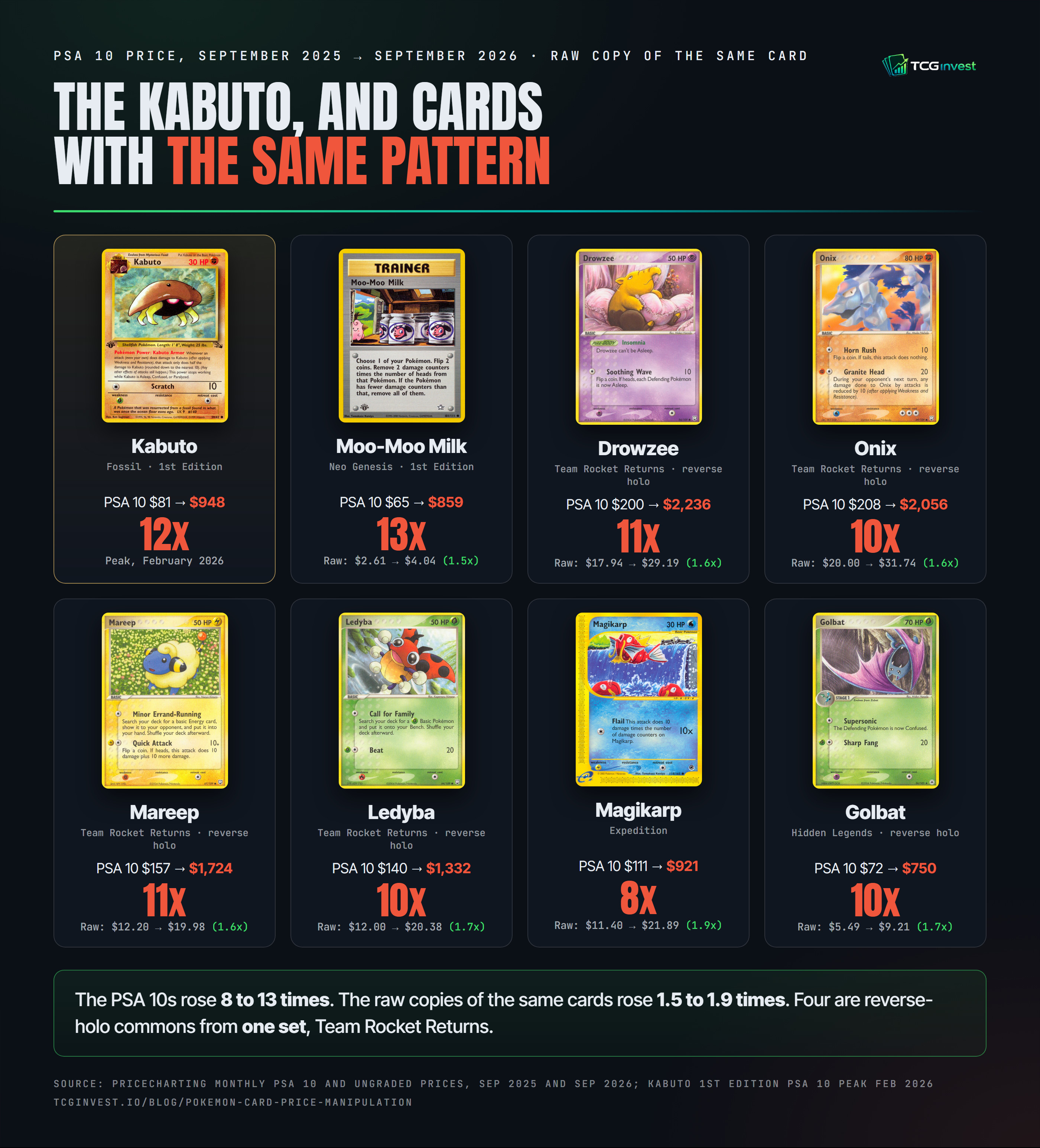
Eight vintage cards with the same pattern: PSA 10 prices up 8 to 13 times in a year, raw copies of the same cards up 1.5 to 1.9 times.
| Card | PSA 10 | Raw |
|---|---|---|
| Moo-Moo Milk 1st Ed. | $65 → $859 | 1.5x |
| Drowzee, TRR | $200 → $2,236 | 1.6x |
| Onix, TRR | $208 → $2,056 | 1.6x |
| Mareep, TRR | $157 → $1,724 | 1.6x |
| Ledyba, TRR | $140 → $1,332 | 1.7x |
| Magikarp, Expedition | $111 → $921 | 1.9x |
PSA 10 prices September 2025 to September 2026; "Raw" is how much the ungraded copy of the same card rose over the same year. TRR = Team Rocket Returns reverse holo.
Four of them are reverse-holo commons from one set, Team Rocket Returns, all climbing in the same months.
Copycats, or something else?
People saw copycats coming: in December 2025 one Pokémon news site noted that copycat "King" accounts were trying the same idea on other cheap commons, such as Totodile and Omanyte. But the timing alone does not prove anything, and other explanations fit the same pattern:
- Set builders. Collectors completing a set in PSA 10 on the PSA registry bid up the last commons they need. That would explain clusters inside one set, like the four Team Rocket Returns cards.
- New money in vintage. The count was already rising in mid 2025, before he went viral.
- Real scarcity of perfect copies. Some old commons are very hard to grade a 10, so the PSA 10 can rise on its own.
- Thin data. Many of these cards sell a handful of times a year, so one or two high sales can triple the price.
What they share is the same weakness: on a card that trades a few times a year, a few buyers set the price everyone sees, and every app that shows a PSA 10 value repeats it.
The $8.4 million Pikachu
In late September a 2015 Japanese Art Academy Pikachu, the one in the yellow raincoat, sold in PSA 10 for $8.4 million at Fanatics Collect after 64 bids (Kotaku). In June another PSA 10 of the same card sold at Heritage for $156,250. In August one went for $79,999.99 on eBay. In 2025 they sold for $17,400 and $26,100.
It is not a single-digit-pop slab: PSA lists 57 copies in PSA 10. One of those copies sold for 54 times what another fetched three months earlier.
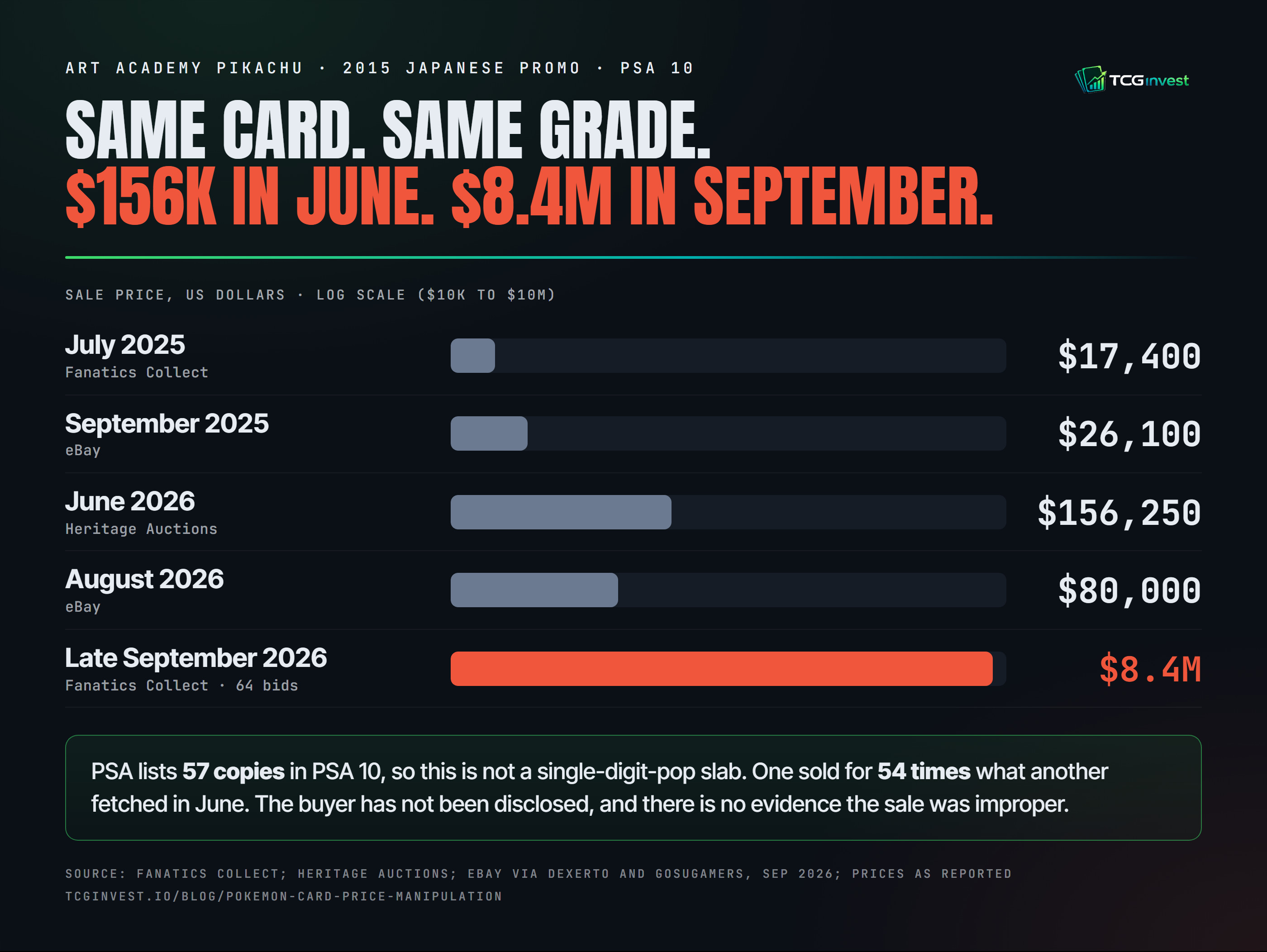
Art Academy Pikachu PSA 10 sales: $17,400 and $26,100 in 2025, $156,250 in June 2026, $8.4 million in September 2026.
Results far above recent comparables, with an undisclosed buyer, naturally attract speculation. There is no evidence that the $8.4 million sale was manipulated, unpaid or improper.
Fanatics acquired PWCC in 2023 and later renamed the marketplace Fanatics Collect. Before that, in August 2021, eBay removed PWCC's live auctions after saying that individuals associated with PWCC had engaged in shill bidding. PWCC disputed it. A 2021 consumer lawsuit against PWCC was dismissed in January 2022 with leave to amend, and that order made no finding of shill bidding. A separate lawsuit filed by Alt in 2025 alleges shill bidding in past PWCC sports-card auctions; the allegations are contested, and Fanatics is not named as a defendant.
The relevant point for this article is narrower: when a card has very few comparable sales, one completed auction can change the price the whole market sees.
The biggest Pokémon card sales of 2026
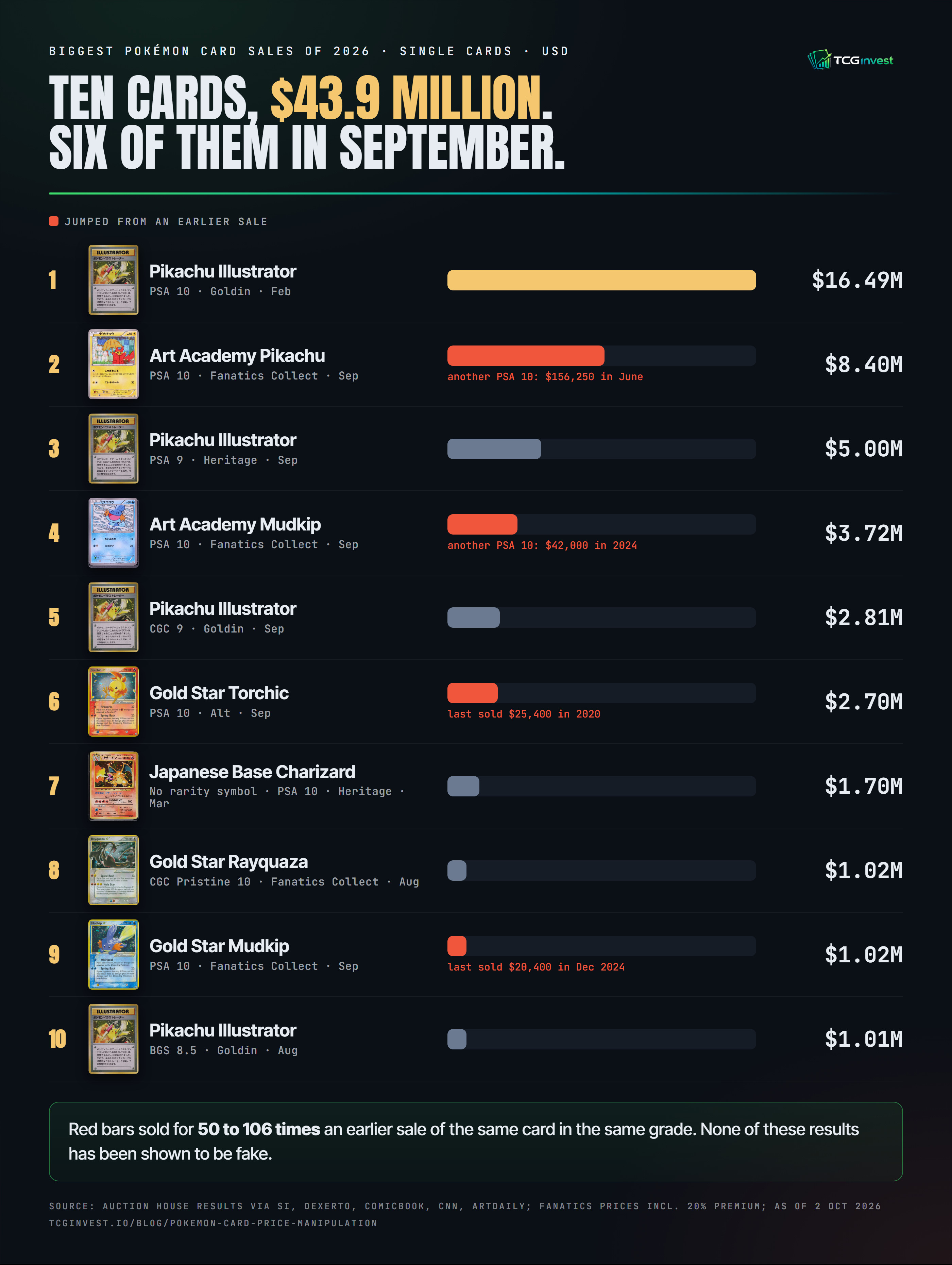
The ten biggest single-card Pokémon sales of 2026 total $43.9 million; six of them were in September.
The ten biggest single-card Pokémon sales of 2026 add up to $43.9 million, led by the $16.49 million Pikachu Illustrator at Goldin in February. Four of them sold for 50 to 106 times an earlier sale of the same card in the same grade:
- Art Academy Mudkip PSA 10: $3.72 million at Fanatics Collect on 25 September, after 61 bids (SI). Another PSA 10 sold for $42,000 in November 2024.
- Gold Star Torchic PSA 10: $2.7 million at Alt on 10 September (ComicBook). It last sold for $25,400 in 2020.
- Gold Star Mudkip PSA 10: $1.02 million at Fanatics Collect in September (ComicBook). Last sale, $20,400 in December 2024.
- Art Academy Pikachu PSA 10: $8.4 million, 54 times June's $156,250.
None of these results has been shown to be anything but genuine. They share one thing with the breakouts above: very few comparable sales, so one result resets the price.
The other theory: are low-pop PSA 10s being pumped?
The most repeated theory on Reddit is that people buy whatever low-population PSA 10 they can find and push its price up. If that were happening at scale, low-pop PSA 10s should show the shape of a pump more often than common slabs: a sudden jump, then a fall back.
We took every card where we could tie one PSA pop listing to one PSA 10 price history: 1,810 cards, with monthly PSA 10 prices from January 2021 to September 2026 and pop counts from PSA's report in June 2026. A spike is a month where the price reaches 1.5 times its level over the previous three months. A spike fades if the price falls back to within 15% of that level in the next three months.
The rarest PSA 10s spiked the least
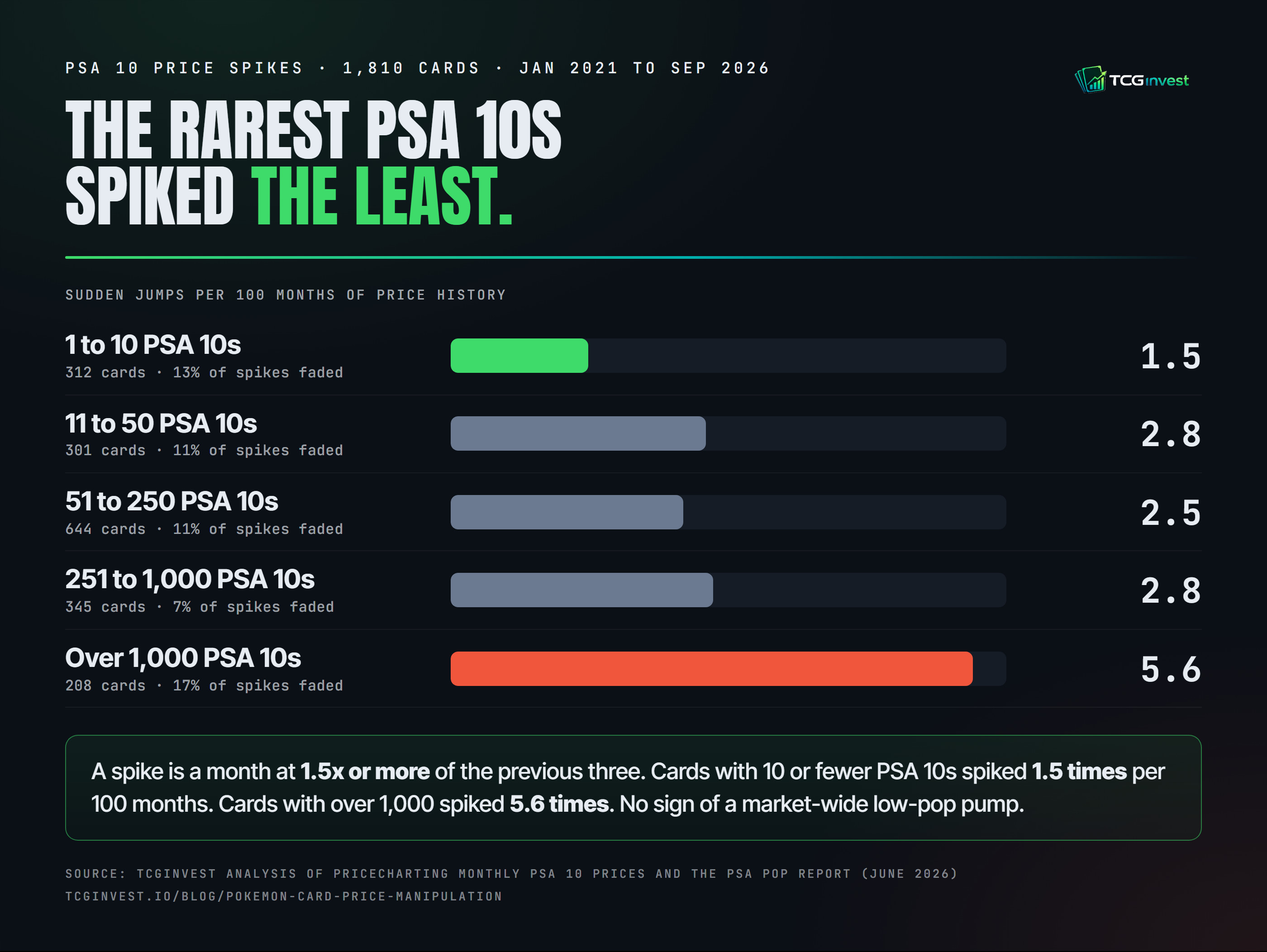
Sudden PSA 10 price jumps per 100 months: 1.5 for cards with 10 or fewer PSA 10s, 5.6 for cards with over 1,000.
| PSA 10 pop | Cards | Spikes per 100 mo | Faded |
|---|---|---|---|
| 1 to 10 | 312 | 1.5 | 13% |
| 11 to 50 | 301 | 2.8 | 11% |
| 51 to 250 | 644 | 2.5 | 11% |
| 251 to 1,000 | 345 | 2.8 | 7% |
| Over 1,000 | 208 | 5.6 | 17% |
The cards with the fewest PSA 10s spiked the least. The cards with the most, the modern chase cards that everyone owns, spiked the most and faded the most.
This is enough to reject the simple claim that low-pop cards obviously spike more often. It is not a causal test: high-pop cards are also newer, more liquid and more traded, which gives them more chances to jump.
One sale, or one bad number, becomes the price
When the price of a pop-1-to-10 card does move, the median change is about 1%. That is a price guide estimating, because almost nobody sells these cards.
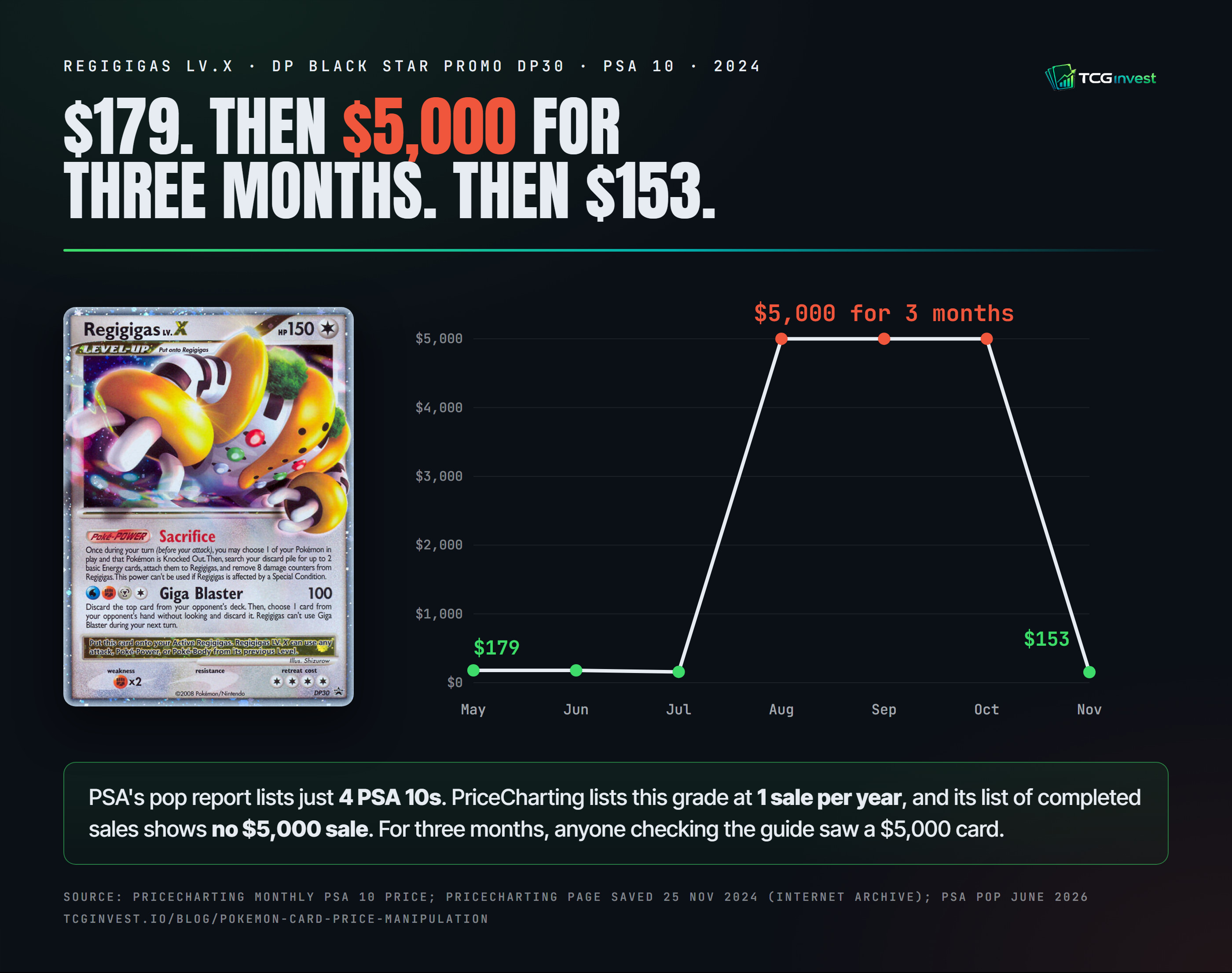
Regigigas LV.X PSA 10: $179, then $5,000 for three months, then $153, with no $5,000 sale in its sales list.
Regigigas LV.X, a DP Black Star Promo with 4 PSA 10s on the June pop report: $179 in May 2024, then $5,000 in August, September and October, then $153 in November. When PriceCharting corrected it, its own page showed the PSA 10 price at $152.47, "down $4,847.53", with a volume of "1 sale per year", and no $5,000 sale appears in the card's list of completed sales (PriceCharting page saved by the Internet Archive, 25 November 2024).
A misleading displayed price does not require manipulation at all. In a thin market, one unusual sale or one bad data point is enough.
What has actually been proven
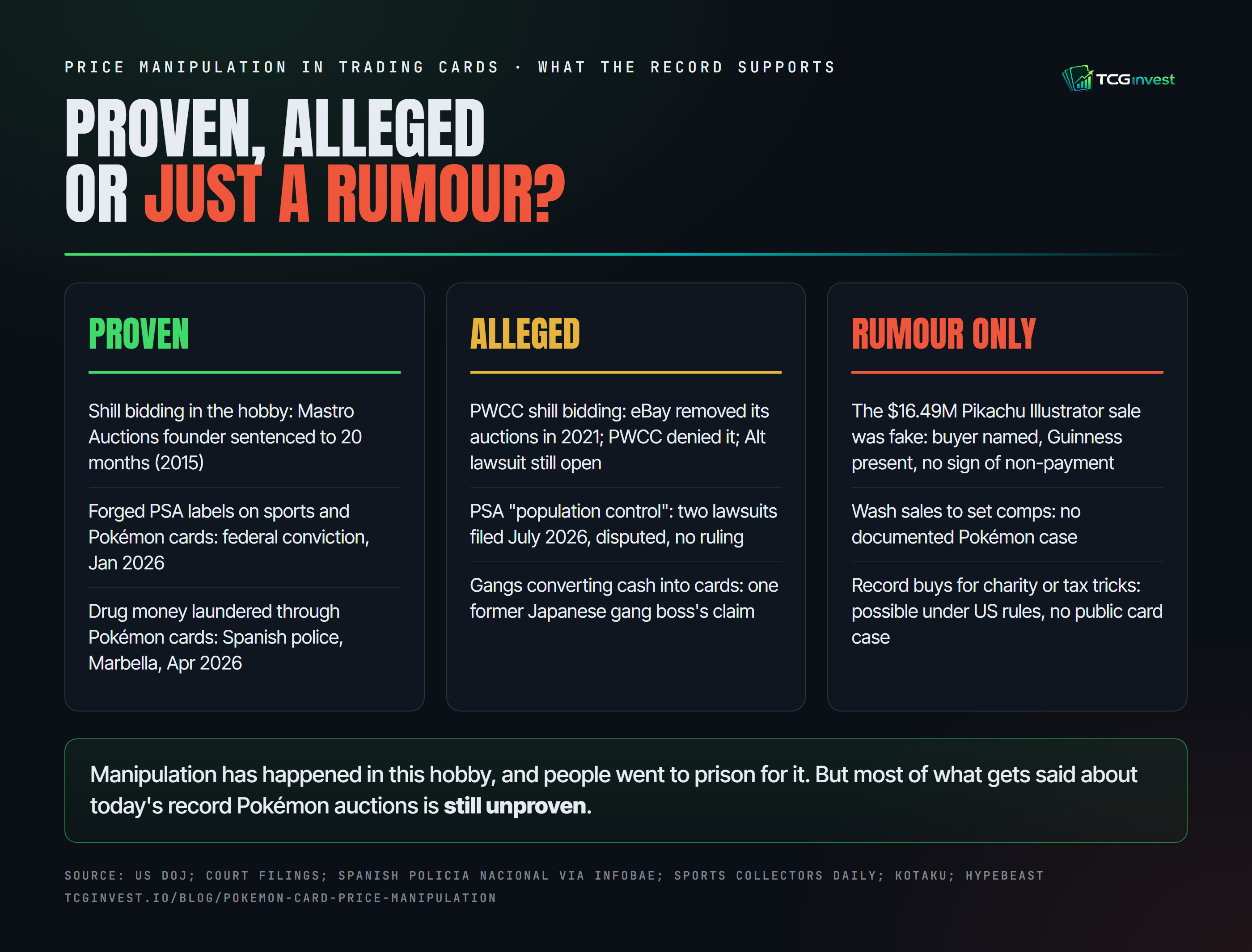
What the record supports: proven cases, open allegations, and claims that are rumour only.
Proven
- Shill bidding in collectibles. Bill Mastro, founder of Mastro Auctions, was sentenced to 20 months in federal prison in 2015 for shill bidding and card trimming in sports memorabilia auctions.
- Forged grades. In January 2026 a federal jury convicted a seller in a scheme involving sports and Pokémon cards with forged PSA grades.
- Laundering through Pokémon cards. In April 2026 Spain's Policía Nacional and Swedish police broke up a network that turned drug money into Pokémon cards, with an arrest in Marbella.
Alleged, not proven
- PWCC shill bidding: eBay's 2021 action and the Alt lawsuit of 2025, both disputed by PWCC.
- PSA grading and population reports: two lawsuits filed in July 2026 (Funk v. Collectors Universe, D. Md., and Lichtman v. Collectors Universe, C.D. Cal.) allege that PSA's grading practices distort grades and population reports (summary). PSA disputes them and nothing has been proven in court.
- Gangs and cards in Japan: a former gang boss told a magazine that fraud groups turn stolen money into Pokémon cards. Japan's parliament is discussing regulation.
Rumour only
- That the $16.49 million Pikachu Illustrator sale was fake. The buyer was named, a Guinness adjudicator was present, and the debate is about the card's grade.
- Wash sales to set comps: we found no documented Pokémon case.
- Record buys made for tax reasons. Since 2018 collectibles can no longer be swapped tax-free, and donating a card at full market value needs a qualified appraisal and a charity that uses it, such as a museum (IRS Publication 561). We found no public case involving a Pokémon card.
One more fact about population reports: when a slab is cracked and resubmitted, the old grade usually stays in PSA's count unless the owner sends the label back, so a pop report counts submissions rather than unique cards.
What this means for your collection
- A price is only as good as the sales behind it. A card that sells 60 times a month is much harder for one buyer to move than a card that sells once a year.
- Be careful with cheap vintage commons whose PSA 10 has suddenly tripled. If the raw card has not moved, the price rests on a few buyers of the slab, not on demand for the card.
- In our data, the jumps most likely to fall back were on modern chase cards, not rare slabs.
A $5,000 price means very little if the card sells once a year. On TCGinvest you can check a card's raw and graded prices, its PSA population, its recent sales and how easy it is to sell, before trusting the headline number. Already own cards? Add them to a free collection and see what they are really worth. Check a card · Start a free collection
Methodology. Data downloaded and analysis run on 2 October 2026. Prices are PriceCharting monthly figures in US dollars: these are market prices built from completed sales, not individual transactions, which is why we call our events breakouts rather than sales or pumps. Breakouts: vintage means sets released before 2010, applied to every card the same way, to keep out modern release cycles and reprint supply shocks. We tracked about 7,600 vintage prints with both a PSA 10 and an ungraded price. A breakout is the first month a print's PSA 10 price reaches three times its median of six to four months earlier, while its ungraded price rose less than 50% over the same six months, counting only PSA 10 prices of at least $15. We repeated the count with 2x, 2.5x and 4x jumps and a 100% raw limit; the acceleration held under all of them. The raw price is used only as a control for broad demand for the card, not as an estimate of the chance a raw card grades a 10. Population test: we kept only cards where one PSA listing and one price history clearly refer to the same card (1,810 cards) and months where the earlier price was at least $20. Cards are grouped by their June 2026 population, not their population at the time of each spike, so the test asks whether cards that are low-pop today spiked more often, not whether they were low-pop at that moment. A spike is a month at 1.5 times or more the median of the previous three months; it fades if the price returns to within 15% of that level within three months. The population buckets are descriptive and do not control for era, price or trading volume. Auction results are as reported by the auction houses and the outlets linked above. Nothing here says any named buyer, seller, auction house or grading company did anything wrong unless a court has found it.