
On 23 July, a policy group inside Japan's ruling party held its first meeting on regulating trading cards, saying they are "no longer simply consumer products." Nothing has been drafted.
The more useful question is not what Japan will write. It is what a rule of that shape would actually catch, and Europe has been running one for six years. Since 2020 the Fifth Anti-Money Laundering Directive has required identity and source-of-funds checks on any art transaction of €10,000 or more. Cards are not currently in scope. Japan's meeting is the first serious suggestion by a government that they might belong there.
So we ran Europe's existing line against the cards Europeans and Americans actually buy.
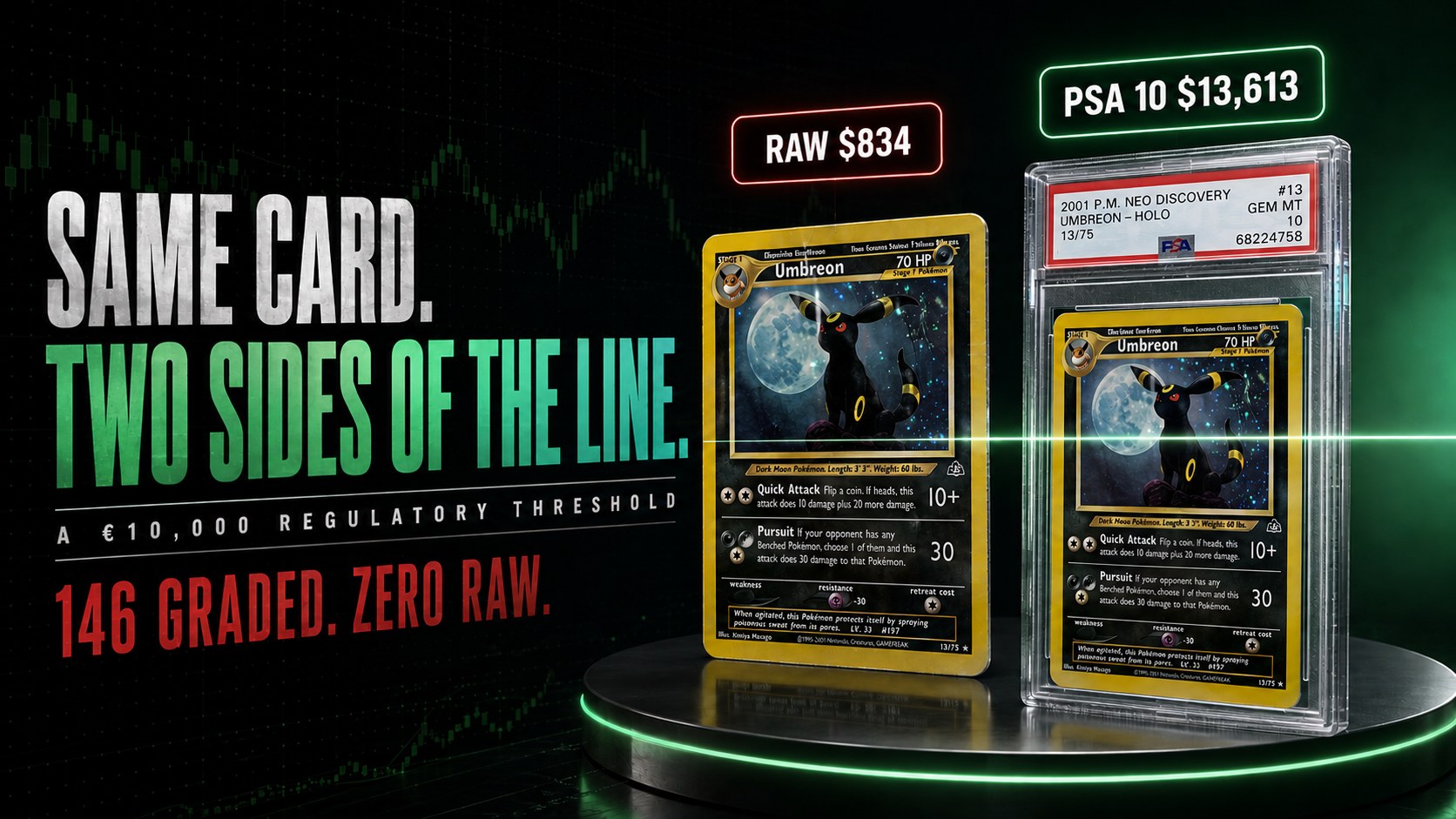
Across the 13,638 cards where we hold both a raw and a PSA 10 price, 146 sit at or above $10,000 graded. Raw, the same 13,638 cards yield none. Not a handful. Zero.
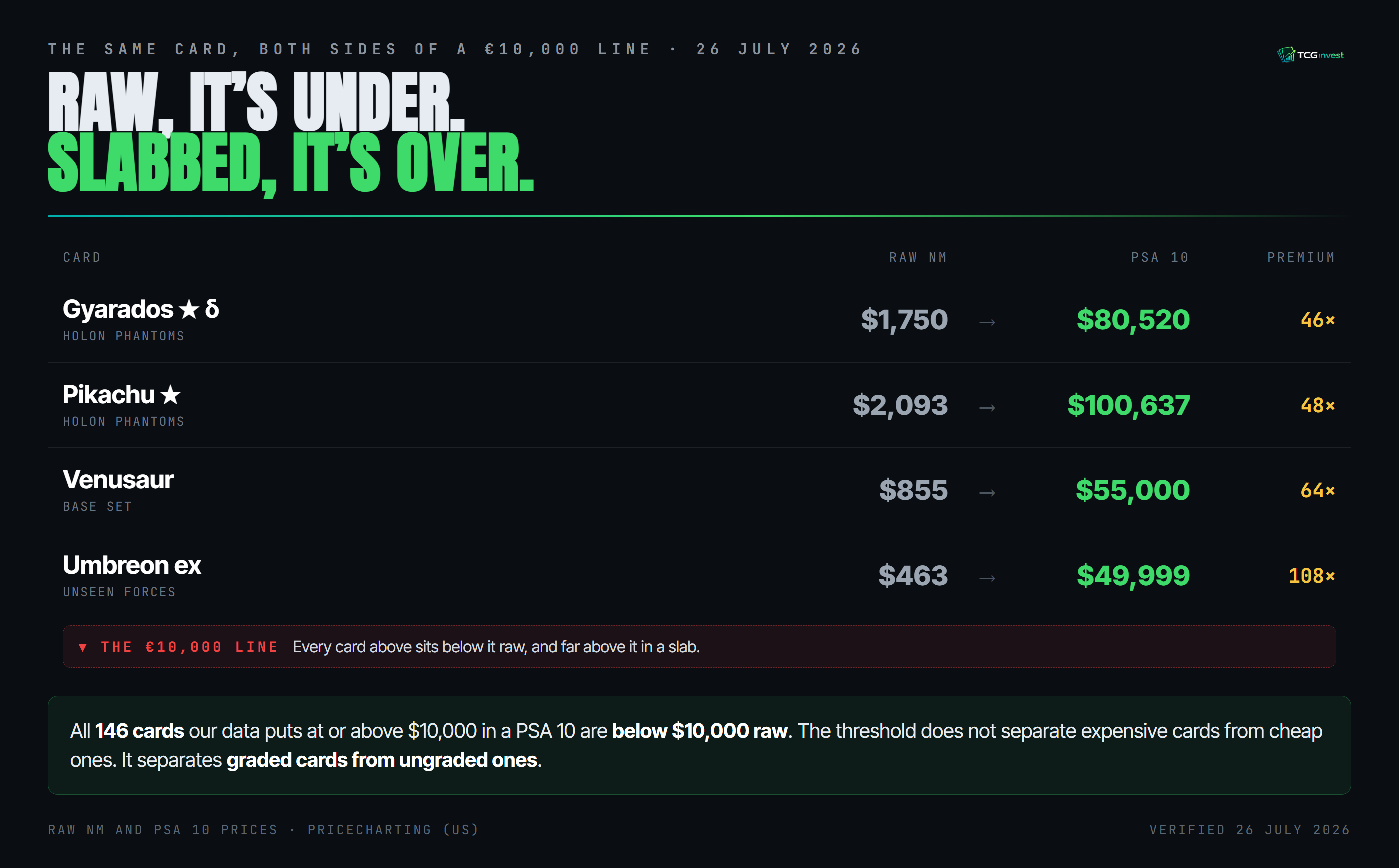
Of those 146, we hold a raw price for 136. Every one of the 136 is below $10,000, and the highest raw price among them is $6,016. The same card sits on opposite sides of the line depending on whether it is sealed in a slab.
A raw Umbreon ex from Unseen Forces sits around $463; the PSA 10 is near $49,999. A Base Set Venusaur is about $855 raw and $55,000 graded.
We price English-language cards sold in the Western market. This is deliberately not a prediction about Japanese card prices under a Japanese law, which would need Japanese market data we do not hold.
It is the answer to a narrower question with a clearer bearing on most readers: if the threshold Europe already applies to art were extended to cards, what would it reach in the collections Europeans and Americans own?
Why the art rule is the one to look at
Three concerns were raised at the Japanese meeting: counterfeiting, money laundering, and traceability. In May, coordinated raids in Spain and Sweden linked a criminal organisation's laundering scheme to Pokémon cards. Japan's domestic trading card market reached ¥338 billion (about $2.1 billion) in fiscal 2025, up roughly 90% in four years.
Those are the concerns that produced 5AMLD. It pulled art dealers, galleries, auction houses and freeports into the same regime as banks. The United States followed for art and antiquities dealers in 2021.
What it did in practice is the useful part. The top of the market got paperwork. The bottom was untouched, because nobody files a KYC form to buy a €40 print. Prices did not collapse; the market kept working with more friction at the top.
Kihara, who chairs the Japanese group, has separately cited cryptocurrency as a warning about regulation heavy enough to push an industry offshore. That is not the language of someone planning a crackdown. But the machinery for a threshold already exists on this side of the world, which is why it is worth testing rather than assuming.
What the threshold actually catches
| Price line | At or above, PSA 10 | At or above, raw NM |
|---|---|---|
| $1,000 | 1,415 | 38 |
| $5,000 | 354 | 3 |
| $10,000 | 146 | 0 |
| $25,000 | 40 | 0 |
Measured across the same 13,638 cards, on 26 July 2026.
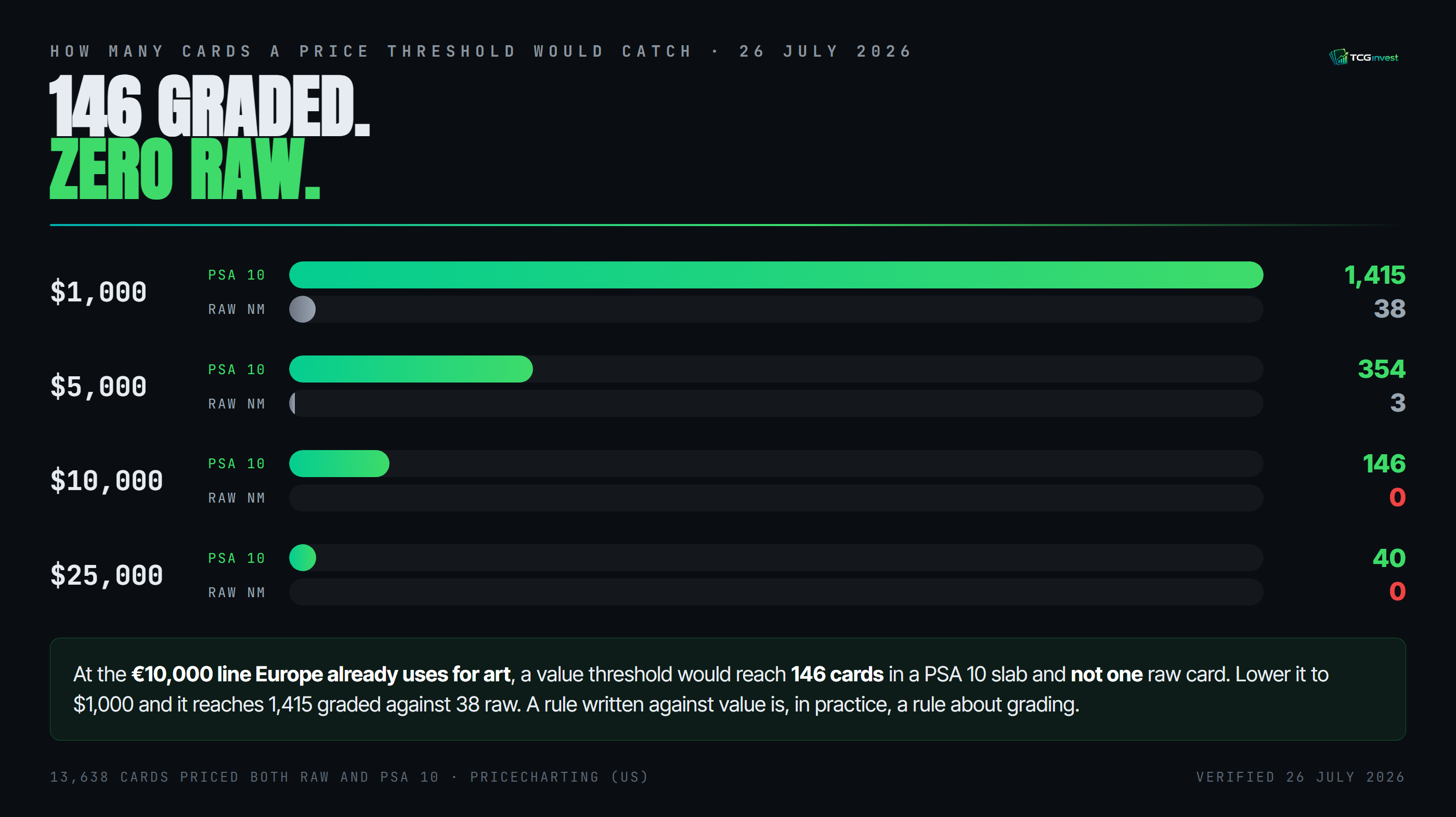
At €10,000 the rule reaches 146 cards. At €1,000 it reaches 1,415, roughly ten times as many.
A value rule lands almost entirely on certified cards moving through dealers, auction houses and grading companies, and barely at all on someone buying a raw card at a show. That is not a legal distinction anyone has proposed. It is arithmetic.
The reason the gap is so wide is condition scarcity. What collectors pay for at the top of this market is not the card, it is the grade: encapsulating one of the small number of gem-mint survivors produces multiples that raw copies almost never reach. On the cards nearest that line, the premium runs from roughly 30x to over 100x.
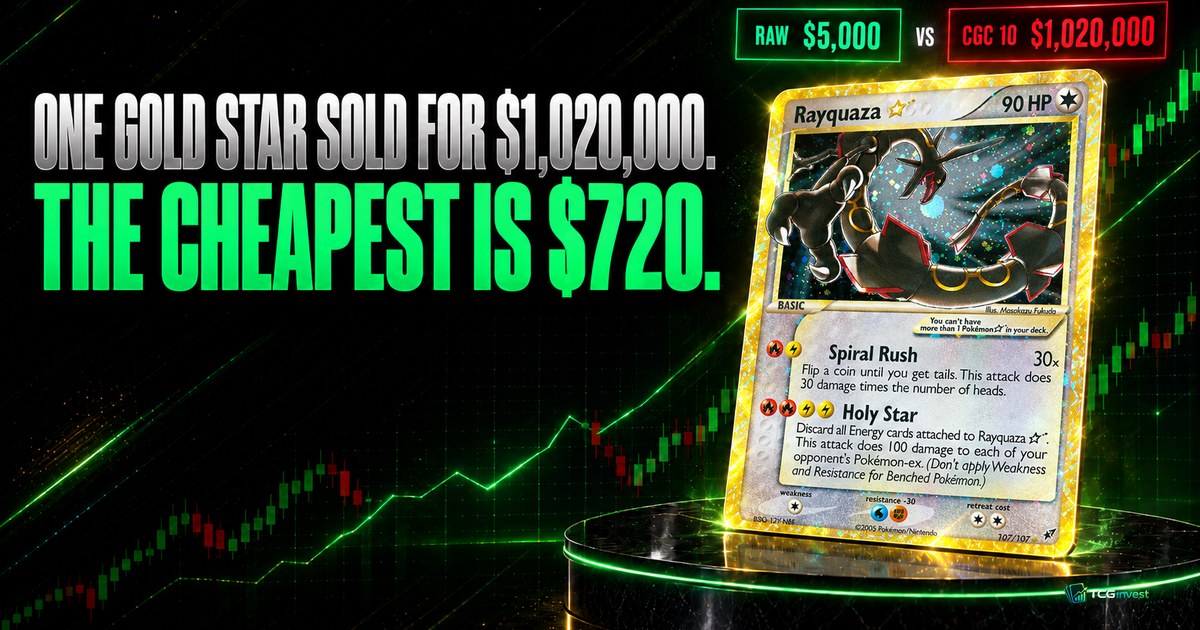
One boundary, because it is the first objection anyone will raise: raw cards worth more than $10,000 do exist. Pikachu Illustrator, the early Japanese trophy cards, an exceptional 1st Edition Shadowless Charizard. None of them is in this dataset. We price English-language sets, so the trophy cards are outside it entirely, and a reference Near Mint price does not capture what one exceptionally preserved copy fetches at auction. Our raw prices top out at $6,016, a Rayquaza Gold Star from Deoxys.
What is worth watching
- Where the number lands, for the reason above.
- Whether it targets cross-border sales specifically. Traceability of goods leaving a country was the stated Japanese concern. A rule aimed there would affect exporters and proxy buyers more than domestic collectors.
- Whether authentication becomes mandatory at some value. If it did, more of the market would likely route through graders, and as the table shows, graded and raw prices already behave nothing alike.
Whatever Japan eventually writes, and whether or not Europe ever extends its own rule to cards, the arithmetic above is what decides who a value threshold reaches. It is not really a rule about expensive cards. It is a rule about grading.
Price bands and card counts computed from our own price database on 26 July 2026, across English-language sets sold in the Western market; we do not price Japanese-language cards. Market data from Cardmarket (EU) and PriceCharting/TCGplayer (US), measured daily. Regulatory details from the Liberal Democratic Party policy group meeting of 23 July 2026 as reported by The Japan Times, Bloomberg and IBTimes, and from Directive (EU) 2018/843. Nothing here is financial or legal advice.